

Can spravato and spirituality meet in one person’s experience without spirituality being an expected effect of treatment? It’s understandable to wonder what an unusual or deeply personal moment might mean, especially when Spravato can involve dissociation, such as feeling detached from yourself, your thoughts, or time. Some people may interpret an experience through a spiritual lens; others may not feel anything spiritual at all.
Neither response is a measure of treatment success. This article looks at how personal meaning can coexist with clinical treatment, while distinguishing subjective experience from what research can establish. You’ll learn why spiritual feelings aren’t guaranteed or required, how to reflect without pressure to label an experience, and how music and gentle preparation may shape your attention and surroundings. These can support personal reflection, but they don’t replace medical care or promise a particular outcome. Your beliefs and interpretations remain your own.
Key Takeaways
- Spirituality can mean a personal sense of meaning, connection, values, or transcendence, whether religious, cultural, secular, or individual.
- With spravato and spirituality, interpretations vary. A spiritual feeling isn't an expected effect or proof of how treatment works.
- Separate clinical information from personal belief, and keep reflection optional. You don't need to find a particular meaning in your experience.
- Music may shape the atmosphere or focus of a session, but it doesn't promise a spiritual or clinical outcome. Silence or another listening choice may feel more comfortable.
- Gentle reflection can help you notice what stood out. Bring treatment questions to your clinician, and use educational resources to prepare without replacing care.
What Does Spirituality Mean in the Context of Spravato?
Spirituality can describe an individual sense of meaning, connection, values, or transcendence. For one person, it may be rooted in religious belief or practice. For another, it may involve cultural traditions, relationships, time in nature, or a sense of connection to something larger than the self. Some people prefer secular language; others are unsure what words fit. Each perspective deserves room.
Spirituality in a Spravato experience is a person’s own way of interpreting meaning or connection; it isn’t a clinical outcome or an effect treatment promises. This distinction matters when considering spravato and spirituality: personal meaning can be real to the person experiencing it while remaining separate from what clinical evidence can establish. For background on the medicine itself, see Esketamine (Spravato).
Why Patients May Connect Treatment With Meaning
An emotionally significant experience can invite reflection. A person might think about a relationship, a value, a memory, or a question that feels newly present. They may understand that moment through faith, culture, personal history, or no spiritual framework at all. The interpretation belongs to them; it doesn’t need to be universal to matter.
It helps to distinguish two kinds of explanation. A clinician can discuss treatment, symptoms, and medical questions within a clinical framework. A patient can explore what an experience means in the context of their own life. Strong emotions, vivid imagery, or a sense of intensity don’t prove spiritual significance, just as a spiritual interpretation doesn’t establish how esketamine works.
Spirituality Is Personal, Not a Treatment Requirement
No religious belief, spiritual practice, or mystical experience is required. You can approach treatment in clinical or secular terms, bring a religious or cultural perspective, remain undecided, or use different language from one day to the next. You don’t have to adopt someone else’s interpretation of what an experience should mean.
Sometimes, nothing feels especially meaningful. A neutral session doesn’t mean treatment failed, and it isn’t evidence that you missed an insight. Experiences can differ between people and from one session to another. If reflection feels helpful, notice what stayed with you and consider whether it connects to your life. If it doesn’t, you can leave it there. The aim isn’t to produce a spiritual story, but to make room for your response without pressure.
How Can Spravato Experiences Relate to Spiritual Interpretation?
Spravato experiences are subjective. One person might describe feeling calm, noticing imagery, or experiencing emotional distance; another might report no notable shift. These are examples of individual descriptions, not effects everyone should expect. Experiences may also differ from one session to another, so someone else’s account can’t predict yours.
A spiritual interpretation is one way someone might make sense of a feeling or image. It isn’t the same as a clinical explanation. A moment that feels connected, vivid, or significant can matter personally without revealing why it occurred or what it means medically. A meaningful experience is not proof of a specific mechanism of action.
The Difference Between Experience and Explanation
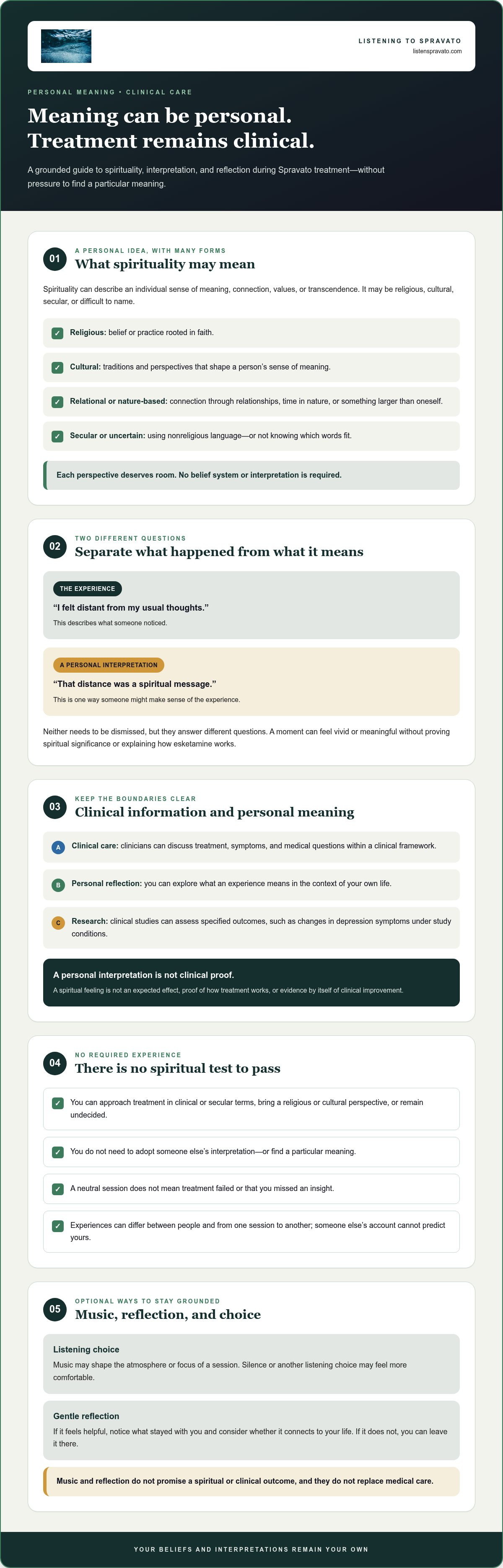
It can help to separate what you noticed from the story you attach to it. “I felt distant from my usual thoughts” describes an experience. “That distance was a spiritual message” is a personal interpretation. Neither statement needs to be dismissed, but they answer different questions.
Spravato is not interchangeable with psychedelic-assisted psychotherapy. Similar-sounding descriptions of altered or unusual experiences don’t establish that the treatments work in the same way, use identical mechanisms, or provide the same therapeutic process. Personal meaning also doesn’t independently establish clinical efficacy or show that a particular experience caused improvement.
What Clinical Evidence Can and Cannot Say
According to current FDA prescribing information, Spravato (esketamine) is approved for adults with treatment-resistant depression, including as a monotherapy, and for depressive symptoms in adults with major depressive disorder who have acute suicidal thoughts or behaviors. These are clinical indications. They don’t define treatment as spiritual or promise a particular inner experience.
Clinical research can assess specified outcomes, such as changes in depression symptoms under study conditions. It doesn’t, by itself, determine whether an individual experience carries religious or personal meaning. Study results cannot tell every person what they will feel, and a reported experience alone cannot establish cause or mechanism. Keeping those boundaries in view doesn’t require discounting what an experience means to you.
If sound is part of your preparation, music and reflection resources offer an educational starting point for considering your listening preferences. Music may shape atmosphere or attention, but it can’t guarantee a spiritual experience or replace clinical care.
Is Spravato a Spiritual Treatment? Evidence, Belief, and Expectation
Spravato is a medical treatment, not an established spiritual treatment. A person may experience treatment through a spiritual or religious lens, but that perspective doesn’t make spirituality a clinical indication or promised effect. When considering spravato and spirituality, keep three things distinct: what treatment is for, what someone experiences, and what they believe that experience means.
Clinical Treatment, Personal Meaning, and Spiritual Belief
These categories can coexist, but they answer different questions. A clinical indication concerns the condition a medicine is approved to treat. Personal interpretation describes how someone understands a moment in their own life. Spiritual or religious belief offers a framework for meaning, which may be shared with a community or held privately. None is more correct or therapeutically superior by default.
| Category | What it addresses | Example |
|---|---|---|
| Clinical indication | The medical use of a treatment, as established through regulatory review. | A clinician discusses whether Spravato is appropriate for an approved depression indication. |
| Personal interpretation | The meaning an individual gives an experience. | Someone reflects that a quiet moment helped them think about a relationship. |
| Spiritual or religious belief | A person’s beliefs, tradition, or sense of connection beyond the self. | Someone understands a feeling of connection through their faith, or chooses not to interpret it spiritually. |
Spiritual interpretation neither replaces clinical assessment nor proves that treatment is effective. At the same time, taking clinical care seriously doesn’t require dismissing a person’s beliefs. Personal meaning can matter deeply without establishing a medical claim.
Why Expectations Should Remain Open
Promises of transcendence, revelation, or transformation can place an unfair burden on someone receiving care. They may feel they should experience something profound, or worry that an ordinary, difficult, or unclear session means they did something wrong. It doesn’t. There is no spiritual experience a person must produce for treatment to “count.”
A grounded approach is to stay curious without deciding in advance what an experience should mean. You may find personal significance, feel uncertain, or notice nothing you want to interpret. Each response is valid. Keep medical questions, concerns about symptoms, and treatment decisions within conversation with your treating clinician. Personal reflection can sit alongside that care without taking its place or being imposed on you.
How to Reflect on Spiritual Meaning Without Pressure
Reflection can make room for an experience; it isn’t a test you need to pass. You don’t have to find a message, decide whether something was spiritual, or draw conclusions right away. With spravato and spirituality, an open, unhurried approach leaves space for your own beliefs, including uncertainty or no spiritual framing at all.
If you want to reflect, try these steps when you feel ready:
- Notice: What do you remember feeling, sensing, or thinking? It’s also fine if nothing stands out.
- Describe: Write down what happened in plain language before deciding what it means. A brief note is enough.
- Consider: Does anything connect with a value, relationship, emotion, or question in your life? You can leave the answer open.
- Discuss: Bring treatment questions or concerns to your treating clinician. Reflection can complement care, but it doesn’t replace prescribed treatment or professional support.
If you choose to record a few observations after a session, wait until you feel ready. There’s no need to interpret them immediately. A note such as “I felt settled” or “I’m unsure what stood out” can preserve what you remember without turning it into a conclusion. You can return to it later, or not at all.
Questions That Leave Room for Your Own Interpretation
Try asking, “Did anything feel significant to me, if anything?” or “What emotion or thought stayed with me?” If spiritual language feels natural, consider whether the experience relates to your beliefs or sense of connection. If it doesn’t, ask, “Did this bring a value, memory, or relationship to mind?” These prompts invite reflection without assuming every session holds insight.
When to Bring a Question to Your Care Team
Share distressing experiences, worries about symptoms, or questions about treatment with your treating clinician. Don’t use a personal interpretation as a reason to change, delay, or stop treatment on your own. If you have an urgent or safety-related concern, use the clinical support channels provided for your care, or seek emergency help if there’s immediate danger.
For a structured companion to reflection and preparation, explore the patient guide to navigating the Spravato treatment experience. It offers educational context, not medical advice, and can help you consider your experience without prescribing what it should mean.
Music, Reflection, and a Grounded Spravato Experience
Music can be one part of the environment during a Spravato session. A familiar melody or gentle instrumental sound may help some people settle their attention or shape the atmosphere. It can’t control what happens during treatment, guarantee comfort, or create spiritual insight. In conversations about spravato and spirituality, music is best understood as a personal listening choice, not a spiritual intervention or proven outcome.
How Music Can Support Attention Without Dictating Meaning
There’s no single right soundtrack. Some listeners may prefer instrumental music; others may choose familiar songs, another kind of sound, or silence. Preferences can change, too. Let comfort guide your choice, and keep listening plans consistent with your clinic’s guidance. No genre or playlist can prescribe the meaning of an experience.
Music may provide a steady element in the room, much like a familiar sound can make an environment feel more recognizable. That doesn’t mean it changes the medicine’s effects or directs your attention in a predictable way. If sound feels distracting or uncomfortable, silence may suit you better. Choosing to listen, pause, or have quiet keeps the experience personal rather than prescriptive.
A Guide for Exploring Sound and Personal Reflection
Listening to Spravato is an educational guide for patients and clinicians interested in music and reflection around treatment. It’s available in print, digital, and audiobook editions. Curated Spravato playlists offer listening options, not medical advice or clinical treatment, and don’t promise spiritual or therapeutic results. The resources support consideration of sound while leaving each person free to decide what feels comfortable.
The site also discusses music as a form of therapeutic scaffolding: a possible support for the setting and a person’s attention, not a way to dictate a session’s meaning. The guide includes genre-by-genre music guidance, playlists for treatment phases, and practical session tips. For more context on exploring sound thoughtfully, explore the Listening to Spravato guide at your own pace. Music is optional, and there’s no requirement to interpret your experience in a particular way.
Make Room for Meaning on Your Own Terms
Spirituality may be one way to understand a Spravato experience, but it isn’t an expected effect or proof of a clinical outcome. Your experience might feel meaningful, ordinary, difficult, or unclear. You can reflect if it helps, without pressure to adopt a spiritual interpretation or find a lesson.
Music is a personal choice, too. It may shape the atmosphere or help you focus, but it can’t promise insight or a particular result. Keep reflection alongside your prescribed care, and bring treatment questions to your clinician.
If you’d like an educational companion for considering sound and reflection, explore Listening to Spravato, independently authored by conservatory-trained musician and Spravato patient Justin Page. The guide is available in print, digital, and audiobook editions, with curated playlist resources. Explore it if it feels useful to you. There’s no right experience to pursue, only room to approach yours with care and curiosity.
Frequently Asked Questions
Can Spravato cause a spiritual experience?
Some people may have subjective experiences during treatment that they interpret as spiritual, while others may not. Spravato can involve dissociation, or feeling disconnected from yourself, your thoughts, or time, but that doesn’t mean a spiritual experience will occur. When considering spravato and spirituality, distinguish a person’s interpretation from a proven spiritual effect or explanation of how the medicine works.
Is Spravato a spiritual treatment?
No. Spravato is a medical treatment for approved depression indications, not an established spiritual treatment. A person may bring religious or personal beliefs to their experience, but spirituality isn’t a required part of care or a promised outcome. Discuss clinical questions about treatment suitability or response with the treating clinician. Personal meaning and clinical care can coexist without being treated as the same thing.
Can I bring my spiritual beliefs into Spravato treatment?
Yes. Your beliefs are personal, and you can use religious, cultural, secular, or spiritual language to describe what matters to you. You can also remain unsure or prefer not to frame treatment spiritually. If a belief or practice affects how you’d like to approach a session, discuss your preferences and questions with your treating clinician. No particular interpretation should be imposed on you.
What if I do not have a spiritual experience during Spravato?
That’s completely okay. A session may feel ordinary, unclear, or not especially meaningful, and the absence of a spiritual experience doesn’t mean treatment has failed. There’s no insight or mystical moment you need to produce. If you wish, note how you felt or what stood out without assigning it meaning. Treatment response is a clinical question to discuss with your clinician, not a spiritual test.
Does a spiritual experience mean Spravato is working?
No. A spiritual or meaningful experience doesn’t by itself show that Spravato is effective, explain how it works, or predict your treatment outcome. Personal interpretation and clinical response are different questions. If you’re wondering whether treatment is helping, share your symptoms, changes, and concerns with your treating clinician. They can assess your response in the context of your care rather than relying on one subjective experience.
Can music make Spravato feel more spiritual?
Music may shape the atmosphere or draw your attention, and you might personally find certain sounds meaningful. But music can’t guarantee a spiritual feeling or direct what an experience means. Preferences vary: instrumental music, familiar songs, other listening choices, or silence may suit different people. Follow your clinic’s guidance, and choose only what feels comfortable. Music is an optional part of the environment, not a treatment or promised outcome.


