

For many patients, the silence of a clinical room isn't peaceful. It's a blank canvas where the mind can drift into overwhelming dissociation or the "bad trips" that many fear before their first session. You likely understand the frustration of trying to find internal clarity while distracted by the sterile hum of hospital machinery or generic background noise. It's natural to feel protective of your mental state during such a vulnerable process. We've found that the difference between a chaotic experience and a structured breakthrough often lies in the intentionality of the auditory environment.
These curated soundscapes are the foundations of the most profound ketamine therapy music success stories. This article examines how the strategic application of sound transforms Spravato® sessions into a focused journey of healing. We'll explore the biological synergy between audio and medicine, providing you with a framework for a Safe Sound Container. You'll learn why music is not just an accompaniment but a vital tool for neural plasticity. Our goal is to help you feel empowered to curate your own environment, ensuring every session is a purposeful step toward resonance, dignity, and recovery.
Key Takeaways
- Understand how sound functions as a physical force to modulate the nervous system, providing structure when your internal landscape feels fragmented.
- Discover the specific patterns found in ketamine therapy music success stories that move sessions from chaotic dissociation toward meaningful neural breakthroughs.
- Learn the essential rules for designing a "Safe Sound Container," such as prioritizing high-fidelity audio and removing lyrics to eliminate ego-anchors.
- Identify how the "Listening to Spravato®" guide bridges the gap between clinical neurobiology and your personal journey to foster a sense of safety and purpose.
What is the Sound and Medicine Intersection?
The intersection of sound and medicine represents a profound meeting point between the precision of psychoacoustics and the complexity of clinical neurobiology. It's a space where we treat sound not as a passive background element, but as a physical force. Every sound wave is a vibration that enters the ear and modulates the autonomic nervous system. This interaction becomes especially critical when using Spravato® (esketamine), a treatment that significantly heightens a patient's sensory receptivity. Because the medicine increases the brain's openness to external stimuli, the distinction between passive listening and an intentional therapeutic audio protocol is the difference between a fragmented experience and a cohesive breakthrough.
We don't just listen to music during these sessions; we use it to direct the medicine's potential. When a patient enters a state of deep dissociation, the brain requires a structural framework to process internal imagery. Without this scaffolding, the experience can feel like drifting in a void. By utilizing specific frequencies and rhythms, we can encourage the brain to move out of high-stress states and into a space of receptive healing. This is the biological foundation of the most impactful ketamine therapy music success stories we see today.
The Evolution of Audio Scaffolding
Humanity has long used ritualistic sound to anchor the psyche during states of transition. We've now refined this ancient intuition into evidence-based audio medicine. As of 2026, clinical standards in many US ketamine clinics recognize that "environmental audio" is a primary variable in therapeutic success. This shift moves us beyond simple relaxation tracks toward sophisticated compositions designed to mirror the pharmacokinetic arc of the medicine. A cornerstone of this field is vibroacoustic therapy, which is defined as the application of low-frequency sound vibrations directly to the physical body to facilitate healing. Resources like the Music for Psychedelic Therapy album highlight how modern artists and clinicians collaborate to build these neural pathways.
Why Sound is 50% of the Treatment Setting
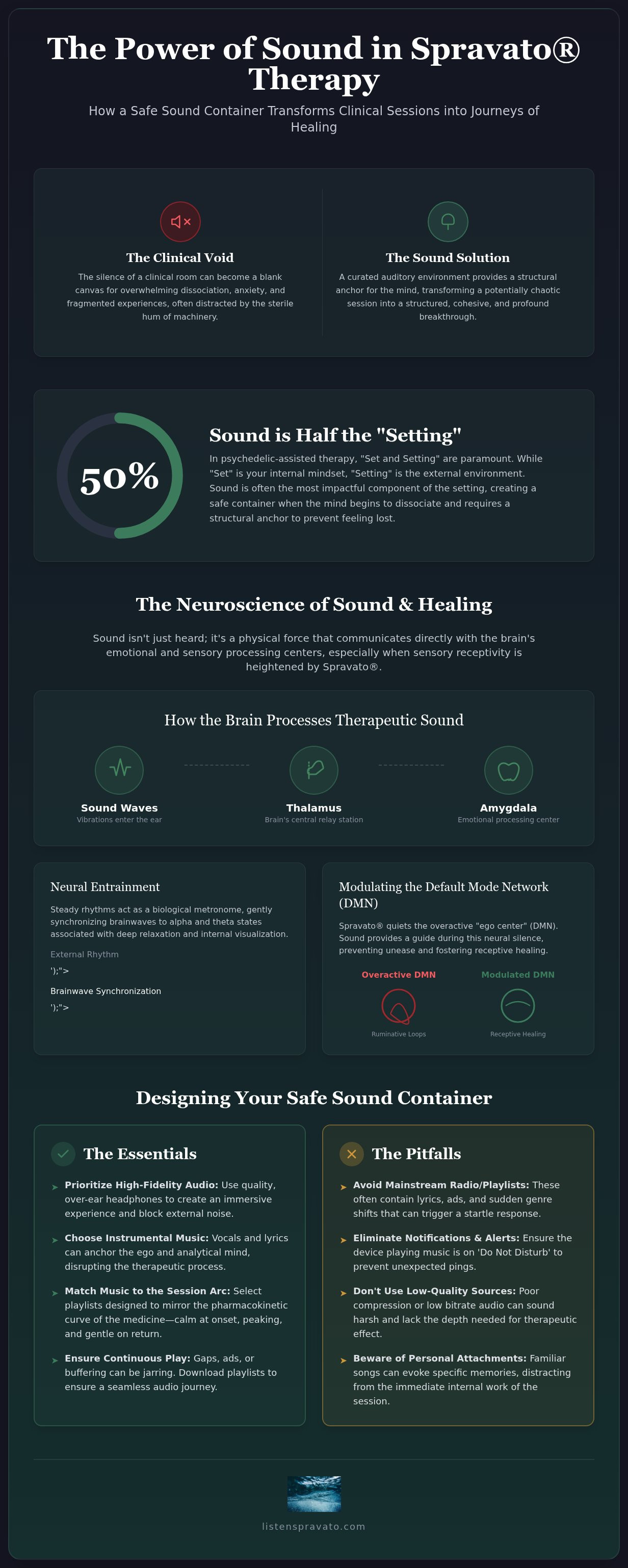
The concept of "Set and Setting" is the bedrock of modern psychedelic-assisted therapy. While "set" refers to your internal preparation, "setting" encompasses everything you feel, see, and hear during the session. Sound is often the most impactful part of this environment. When the clinical world fades and dissociation begins, sound creates a "safe container" that prevents the mind from feeling lost in a vacuum. It acts as a structural anchor. Many ketamine therapy music success stories share a common thread: the music provided a sense of safety when the patient felt they were losing their grip on reality. By preventing sensory overwhelm from hospital hums or unexpected noises, a curated protocol allows the patient to focus entirely on their internal work.
The Neuroscience of Sound: How Frequencies Direct Neural Healing
Sound isn't just "heard"; it's processed as a neurological directive. When sound waves enter the ear, they travel to the thalamus, the brain's central relay station. From there, they interact directly with the amygdala, our emotional processing center. In the context of esketamine, which heightens sensory input, these vibrations can either soothe or agitate. By choosing specific frequencies, we can effectively communicate with the deeper structures of the brain, bypassing the analytical mind to foster a state of safety. This biological dialogue is what allows for the profound shifts documented in many ketamine therapy music success stories.
Neural entrainment is the process by which brainwaves synchronize with external rhythms. Steady, repetitive beats act as a biological metronome, gently pulling the brain into alpha or theta states. These states are associated with deep relaxation and internal visualization. When the medicine begins to dissolve the boundaries of the ego, these rhythms provide a steady pulse to follow. They ensure that the brain remains in a state of receptive healing rather than falling into a "startle response" triggered by hospital pings or sudden noises.
Modulating the Default Mode Network
The Default Mode Network (DMN) is often described as the "ego center" of the brain. In patients with treatment-resistant depression, this network is frequently overactive, fueling ruminative thought loops and negative self-talk. Spravato® works by temporarily quieting the DMN, creating a rare window of "neural silence." However, this silence can feel unsettling without a guide. Understanding how music affects the ketamine experience reveals that intentional audio fills this void. It provides a constructive narrative that prevents the mind from drifting back into old, harmful patterns.
Frequency and Parasympathetic Activation
The choice of frequency directly impacts the body's stress response. Low-frequency, drone-like textures encourage parasympathetic activation, the "rest and digest" state necessary for processing trauma. These tones stimulate the release of dopamine and oxytocin, chemicals that promote feelings of trust and well-being. Conversely, jarring or high-pitched sounds can trigger the sympathetic nervous system, causing a spike in cortisol that disrupts the session. If you're looking to build your own healing environment, exploring curated Spravato® playlists can help ensure your auditory landscape remains supportive and harmonious.
Ultimately, music provides the structural map for the neuroplasticity triggered by the medicine. While the drug creates the opportunity for new neural connections, the music provides the context and emotional direction for where those connections should lead. It's the difference between a random burst of growth and a carefully tended garden.
Ketamine Therapy Music Success Stories: Real-World Evidence
Success in esketamine therapy is rarely the result of the medication alone. It's the byproduct of a meticulously prepared environment. We see this most clearly when comparing patients who rely on generic background noise to those who use a structured auditory protocol. These transformations are the heart of ketamine therapy music success stories, where sound serves as the bridge between clinical intervention and emotional resolution. When the medicine opens the door to neuroplasticity, the music provides the direction for where that new growth should lead.
In one notable breakthrough session, a patient struggling with deep-seated trauma found that a specific, non-lyrical track allowed them to visualize their pain as a manageable, external object. Previously, they had used a "random radio" approach, which often introduced jarring advertisements or songs with "ego-anchoring" lyrics that pulled them back into negative thought loops. By shifting to a curated protocol, they moved from a state of defensive agitation to one of profound emotional processing. This shift isn't just anecdotal; it's a repeatable outcome of intentional sound design.
From Chaos to Clarity: A Patient Case Study
Consider the experience of a patient who felt their early sessions were "fragmented" and frightening. They initially listened to a standard meditation playlist that included vocal tracks and unpredictable tempo shifts. This lack of structure led to increased anxiety during the peak of the medicine's effect, a common hurdle in many early ketamine therapy music success stories. We introduced a phase-aligned music protocol designed to mirror the pharmacokinetic arc of the medicine. This included grounding, low-frequency textures during the onset, expansive and atmospheric soundscapes during the peak, and gentle melodic resolution during the integration phase. The result was a radical shift in the patient's ability to make meaning from their experience, turning a chaotic dissociative event into a structured neural breakthrough.
The Clinician’s View: Observations from the Chair
Clinicians are increasingly observing that the right audio protocol reduces "distress calls"-instances where a patient feels overwhelmed by the dissociative state. In 2026, many clinics are adopting the "Listening to Spravato" protocol because it offers a predictable framework for both the patient and the provider. There is a measurable correlation between steady, intentional audio and stable vitals. When a patient is anchored by harmonic resonance, their blood pressure and heart rate remain more consistent throughout the session. We define harmonic resonance as the use of consistent, consonant frequencies to maintain physiological equilibrium. This stability allows the clinician to remain a supportive companion rather than an active intervener, preserving the dignity and flow of the patient's internal journey.
Designing Your Sound Container: Practical Rules for Healing
Designing a "Sound Container" is an act of mindful intentionality. It's the practice of creating a structural boundary that protects your internal experience from the sterile, often distracting environment of a clinical setting. When you prepare for a session with Spravato® (esketamine), you're entering a state of heightened neural plasticity. This means your brain is exceptionally sensitive to every vibration and frequency. To move from a chaotic experience to a structured breakthrough, follow these four foundational rules. Many of the most impactful ketamine therapy music success stories share a common thread: the patient didn't leave their auditory environment to chance.
- Rule 1: Prioritize high-fidelity, over-ear headphones. In-ear buds often fail to provide the total immersion required to block out external pings or clinic staff voices.
- Rule 2: Eliminate lyrics entirely. Words act as "ego-anchors" that pull you back into analytical thought.
- Rule 3: Match the music to biological phases. Your audio should mirror the onset, peak, and return of the medicine.
- Rule 4: Use "lossless" audio formats. Standard compressed streaming can introduce digital harshness that a heightened brain may perceive as jarring.
The Danger of Lyrics in Deep States
Language is a powerful cognitive anchor. When you hear words, your brain's language processing centers remain active as they attempt to decode meaning and narrative. This activity keeps you tethered to your analytical mind, making it difficult to achieve the deep dissociation necessary for emotional breakthroughs. Lyrics often force a specific narrative onto your journey, which might conflict with the insights your subconscious is trying to reveal. Understanding why no lyrics during ketamine infusion is vital for anyone seeking to replicate the results seen in the most profound ketamine therapy music success stories.
Phase-Aligned Selection: Onset to Integration
Your treatment follows a predictable pharmacokinetic arc, and your music should do the same. During the onset, focus on grounding, rhythmic textures that signal safety to the nervous system. As you reach the peak, transition to ambient music for ketamine treatment that feels expansive and boundaryless. This allows the mind to explore without feeling restricted by a rigid tempo. During the return, or integration phase, use melodic, warm sounds that help you gently re-enter the physical world with a sense of peace.
To ensure your session remains uninterrupted, you can access Curated Spravato® Playlists designed to guide you through every phase of the journey. Managing your device should be the last thing on your mind; set your flight mode, start your protocol, and let the sound container facilitate your healing.
Navigating Your Journey with the "Listening to Spravato" Guide
The "Listening to Spravato" guide serves as the essential bridge between clinical neurobiology and your personal journey. It moves beyond theory by providing a definitive protocol for your sessions. Written by Justin Page, a conservatory-trained musician and a Spravato® patient, the guide offers a unique dual perspective. It combines technical expertise with the warmth of a peer who has walked the path. This "Learned Guide" approach is designed to reduce session-day anxiety, giving you the confidence that your environment is meticulously curated for safety and growth.
Many ketamine therapy music success stories begin with a shift in perspective. Instead of viewing music as a distraction, patients begin to see it as the scaffolding for their neuroplasticity. Readers are encouraged to treat their audio protocol not as a casual playlist, but as a "digital prescription" that facilitates neural breakthroughs. The guide's genre-by-genre music analysis provides long-term value, helping you evolve your auditory landscape as your treatment progresses over months or years. By following a structured framework, you ensure that your ketamine therapy music success stories are built on a foundation of intentionality rather than chance.
Why the Audiobook is a Sensory Essential
The audiobook version offers an immersive sensory experience that a printed page simply cannot replicate. It allows you to "hear" the concepts and music references narrated by a professional musician before you ever step into the clinic. This pre-treatment immersion helps familiarize your nervous system with the sounds you'll encounter, further reducing the "startle response" discussed in earlier sections. It's a tool for deep preparation that engages the ears and the mind simultaneously. For a detailed breakdown of how to use these resources, consult the Listening to Spravato book guide.
Your Next Session: A Pre-Flight Checklist
Preparation is the foundation of dignity in the treatment room. Before your next appointment, use this 3-step checklist to ensure your sound container is secure:
- Verify Your Hardware: Ensure your over-ear headphones are fully charged and your device is set to flight mode to prevent interruptions.
- Audit Your Audio: Check that your selection is lyric-free and formatted in a high-fidelity, lossless file type to avoid digital harshness.
- Set Your Intention: Spend five minutes in silence before starting the music, allowing the sound to act as the vessel for your healing goals.
By treating your auditory environment with the same respect as the medicine itself, you transform a clinical procedure into a structured, sacred space. Deepen your healing journey with the Listening to Spravato guide and take control of your path toward resonance and recovery.
Harmonizing Your Path to Recovery
The journey toward mental wellness doesn't have to be a chaotic drift through clinical silence. By understanding sound as a physical force that directs neuroplasticity, you transform your session from a passive event into a structured breakthrough. We've explored how a Safe Sound Container protects the psyche and how specific frequencies modulate the nervous system. These elements are the common threads found in the most profound ketamine therapy music success stories. When you align your auditory environment with the biological arc of your medicine, you create space for genuine, lasting resonance.
You deserve an environment that honors your dignity and facilitates your healing. To build this foundation, explore the Listening to Spravato guide and immersive audiobook. Authored by a conservatory-trained musician and patient, this definitive protocol is used by leading clinics across the US and Europe. It's available in print, digital, and audiobook formats to ensure you have the tools needed for a mindful, intentional experience. Step into your next session with the quiet confidence of a prepared traveler. Your path to clarity is waiting to be heard.
Frequently Asked Questions
What is the difference between music therapy and therapeutic music listening?
Music therapy is a clinical practice facilitated by a credentialed professional who uses active musical interventions to achieve specific health goals. Therapeutic music listening is an intentional, self-guided protocol. It involves the strategic use of curated audio to anchor your internal experience during a session. While both are valuable, therapeutic listening focuses on designing a supportive auditory environment to facilitate the medicine's work rather than active clinical interaction.
Can I listen to binaural beats during my Spravato® session?
You can use binaural beats, but they require stereo headphones to be effective. These frequencies work through neural entrainment to encourage specific brainwave states like alpha or theta. Some patients find the pulsing sensation helpful for grounding, while others find it distracting during deep dissociation. It is often best to test these sounds during your onset phase before committing to them for the entire peak experience.
Why do some songs feel scary or overwhelming during ketamine treatment?
Ketamine significantly heightens your sensory receptivity, making your brain more sensitive to every frequency. Jarring tempo shifts, minor keys, or complex lyrics can trigger a startle response or unwelcome emotional intensity. This is why many ketamine therapy music success stories emphasize the importance of non-lyrical, predictable soundscapes. Consonant and harmonious music helps maintain a Safe Sound Container, preventing the mind from feeling threatened by unpredictable auditory changes.
How long should my therapeutic playlist be for a Spravato® session?
Your playlist should typically span at least two hours to cover the full arc of the treatment. This includes a fifteen minute onset phase, a sixty minute peak phase, and a forty minute integration phase. It's better to have extra music than to have the audio stop while you are still in a deep state. Ensuring the music outlasts the medicine's primary effects prevents the anxiety of sudden, sterile clinical silence.
Do I need expensive headphones for therapeutic listening to work?
You don't need professional studio equipment, but high-quality, over-ear headphones are highly recommended. They provide superior comfort and better noise isolation than standard earbuds. The goal is to create an immersive environment that blocks out hospital hums or office pings. A solid pair of headphones ensures that the low-frequency vibrations and expansive textures of your curated protocol are delivered clearly to your nervous system for maximum resonance.
Is it okay to listen to nature sounds instead of music?
Nature sounds can be grounding, but they often lack the intentional narrative and harmonic structure needed to guide a dissociative journey. Music provides a rhythmic and melodic map that helps the mind navigate complex emotional landscapes. While a babbling brook is peaceful, it doesn't offer the same structural scaffolding as a composed protocol. Nature sounds are often most effective during the integration phase as you gently return to physical reality.
What happens if the music stops during my treatment?
Sudden silence can be jarring and might cause a spike in cortisol or a sense of disorientation. This is why preparation is a cornerstone of a safe session. We recommend downloading your audio for offline use and ensuring your hardware is fully charged. If the music does stop, try to focus on the rhythm of your breath. Treat the silence as a temporary pause while you gently restart your protocol.
How does sound help with treatment-resistant depression specifically?
Sound helps by providing a constructive framework for the neuroplasticity triggered by the medication. It assists in quieting the Default Mode Network, which is often stuck in ruminative, negative loops in those with treatment-resistant depression. By filling that space with structured, resonant audio, you can begin to reframe old thought patterns. This synergy is what leads to the profound breakthroughs documented in ketamine therapy music success stories across the globe.


