

What if the sterile, humming silence of a clinical treatment room wasn't an obstacle to your healing, but a blank canvas waiting for the right frequency? For many, the transition to esketamine therapy feels daunting. You might feel a sense of anxiety about the "unknown" during dissociation or find yourself pulled out of the experience by the persistent sounds of a medical office. It's difficult to know which sounds support the medicine and which ones hinder it.
The Listening to Spravato book, released in March 2026, serves as your essential sensory container. It bridges the gap between medical administration and psychological healing. You don't have to navigate this journey without a map. This guide provides the structure, science, and curated music protocols required to move from a place of confusion to one of deep agency. In this article, we'll examine how these tools help you regulate your emotions and achieve a more meaningful therapeutic result. We'll look at the specific ways music works with the medicine to turn a two-hour monitoring period into a transformative session.
Key Takeaways
- Understand the framework of Music-Assisted Esketamine Treatment and why avoiding lyrics is vital for protecting neuroplasticity during your session.
- Discover how the listening to spravato book utilizes specific genre guides to navigate the critical first twenty minutes of the medication's onset.
- Evaluate the unique benefits of the Print, Digital, and Audiobook editions to determine which format best supports your personal clinic ritual.
- Master the practicalities of clinic setup, from noise-canceling strategies to intentional eye mask selection, to maintain a focused sensory container.
- Gain perspective from author Justin Page, whose background as a conservatory-trained musician and patient offers a rare blend of clinical authority and deep empathy.
Why a Structured Guide is Essential for Spravato®
The administration of Esketamine (Spravato) is more than a simple clinical procedure; it is a profound biological opening. This process is most effective when supported by a framework known as Music-Assisted Esketamine Treatment. Without a structured plan, the two-hour monitoring period can feel aimless or even overwhelming. The listening to spravato book provides the necessary structure to anchor this experience, ensuring every minute of the session serves a clear therapeutic purpose.
Randomly selected playlists often introduce unexpected cognitive friction. Lyrics, specifically, engage the language centers of the brain; this can disrupt the delicate state of neuroplasticity the medicine aims to promote. A structured guide directs you toward abstract, non-verbal soundscapes that allow the subconscious to process emotions without the interference of external narratives. It creates a "safe container" for the dissociative peak of the session, providing a predictable auditory landscape that prevents the startle response common in noisy clinical environments. This intentionality helps reduce post-session confusion by grounding the experience in a curated, familiar rhythm.
The Role of Set and Setting in Modern Psychiatry
Within the context of esketamine therapy, "Set" refers to your internal emotional state and "Setting" refers to the external clinical environment. This book helps you curate both with precision. By engaging in pre-session reading, you establish a mindful intention that carries you through the induction phase. This preparation significantly reduces pre-session anxiety by replacing the "unknown" with a clear, actionable plan. It transforms a sterile medical office into a personalized sanctuary defined by sound and purpose. When you control your sensory input, you reclaim a sense of dignity that is often lost in traditional medical settings.
Bridging the Gap Between Patient Experience and Clinical Protocol
Clinicians typically focus on biological markers like blood pressure and dosage. However, your internal experience is the true engine of healing. Having a physical or digital reference in the treatment room helps you communicate your sensory needs to your providers with clarity. Many clinicians now recommend the listening to spravato book because it standardizes the patient experience across different clinical settings. This guide moves you from being a passive recipient of a nasal spray to an active participant in a sophisticated therapeutic protocol. It ensures that the transition back to ordinary reality after the session is handled with the same grace and intentionality as the onset.
Inside the Book: Music Protocols and Genre Guides
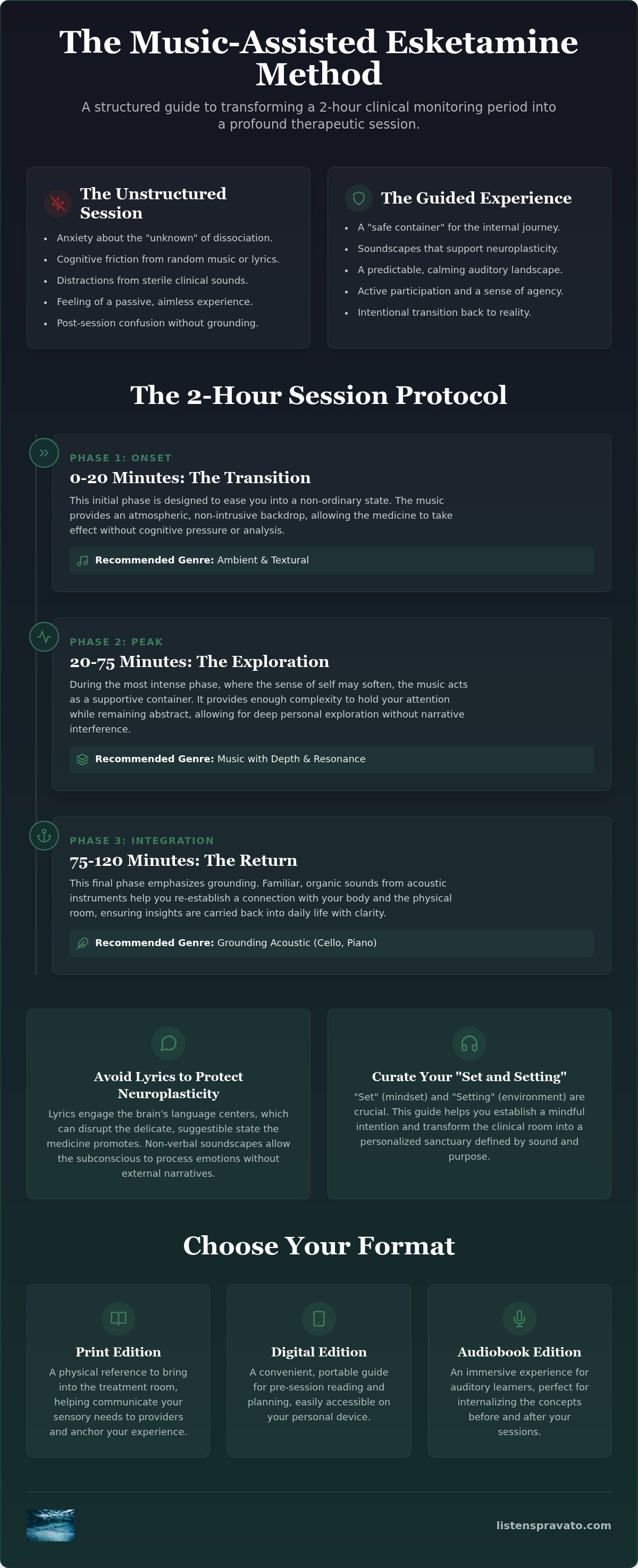
The listening to spravato book serves as a technical manual for the internal journey. It divides the two-hour monitoring period into distinct phases, ensuring that each biological shift is met with a corresponding auditory anchor. Instead of leaving you to wonder what might happen next, the guide provides a map for your consciousness. It moves beyond simple suggestions, offering a sophisticated protocol that respects the seriousness of the treatment.
The Onset Phase covers the first 20 minutes after administration. During this time, the book recommends Ambient and Textural genres. These sounds are designed to ease the transition into a non-ordinary state without being intrusive. By focusing on atmosphere rather than melody, you can settle into the chair and allow the medicine to begin its work without the pressure of "performing" or analyzing what you hear.
As you move into the Peak, the book guides you toward music with greater depth and resonance. This is the most intense phase of the session, where the sense of self often softens. The music here acts as a supportive container, providing enough complexity to hold your attention while remaining abstract enough to allow for personal exploration. It's a delicate balance that the guide manages through meticulously curated genre selections.
Integration is the final "Coming Back" phase. The book emphasizes grounding music, often featuring acoustic instruments like the cello or piano. These familiar, organic sounds help you re-establish a connection with your body and the physical room. This transition is vital for ensuring that the insights gained during the session are carried back into your daily life with clarity and grace.
The Science of Sound and Silence
The "action-and-reason" behind the book's protocols is rooted in neuroscience. During a session within an Esketamine Treatment Program, the auditory environment acts as the primary anchor for the patient’s consciousness. The neurological impact of music on the language center is profound; when the Broca’s area is occupied by processing complex lyrics, it limits the brain’s capacity to engage with the non-verbal, emotional insights often sought during treatment. By prioritizing frequencies and textures over words, the book ensures that your cognitive resources remain available for the work of healing.
Curated Playlists and Customization
While the book provides the theory, it also offers practical tools for immediate use. It includes links to curated Spotify and Apple Music playlists that exemplify the principles discussed in each chapter. You're encouraged to use these as a starting point, but the guide also teaches you how to customize your own journey. The goal is to find a balance between "familiarity," which provides safety, and "novelty," which encourages openness. To see these principles in action, you can browse the Curated Spravato Playlists designed to accompany the text, ensuring your auditory environment is as refined as the medicine itself.
Choosing Your Format: Print, Digital, or the Immersive Audiobook
The effectiveness of a therapeutic guide often depends on how seamlessly it integrates into your specific clinical ritual. Choosing the right version of the listening to spravato book is a matter of matching the format to your sensory needs and the logistical constraints of your treatment center. Whether you prefer the weight of a physical book or the convenience of a digital file, each edition is designed to uphold the same clinical authority and empathetic guidance.
The Listening to Spravato® (Print Edition) serves as a dedicated physical anchor for your sessions. In a clinical environment where digital screens can be overstimulating or distracting, a tactile book provides a grounding point of focus. Conversely, the Listening to Spravato® (Digital/Kindle Edition) offers immediate access and portability. It is ideal for those who prefer to keep their preparation tools on a single device, providing instant links to curated resources and searchability for specific genre protocols. For those who find the most comfort in sound, the Listening to Spravato® (Audiobook) provides a unique, immersive experience narrated by the author, Justin Page.
The Audiobook Experience: Sound as Medicine
The audiobook format is uniquely suited for a treatment that centers entirely on the auditory experience. Hearing the author, a conservatory-trained musician, describe the nuances of sound creates an immediate sense of safety and rapport. This version acts as an effective pre-session "priming" tool; listening to the session stories and music theory on the way to the clinic helps settle the nervous system. It transforms the guide from a set of instructions into a supportive voice that accompanies you right to the threshold of your session.
Comparison of Formats for Clinical Use
Selecting a format often comes down to how you intend to use the guide during the integration phase. The print edition is frequently favored by patients who use the margins for journaling and post-session reflections. Having a physical record of your journey can be a powerful tool for emotional regulation. Digital editions excel in their ability to offer instant navigation; you can jump between genre guides or access the Curated Spravato® Playlists with a single tap. If your clinic environment is particularly bright, the "dark mode" on many digital readers can also be a significant advantage for light-sensitive patients.
This guide is available globally to ensure that every patient has access to structured support. Readers in the US, UK, and Australia can find the various editions through major retailers like Amazon, Walmart, and Kobo. International availability extends to platforms such as Takealot and Booktopia, making it possible for patients worldwide to transform their treatment into a more profound healing experience.
How to Use the Guide Before, During, and After Sessions
The listening to spravato book is designed as a procedural manual that moves you through each stage of your treatment with intentionality. Success begins well before you enter the clinic. Step 1 involves pre-session preparation, where you read the relevant genre guides forty eight hours before your appointment. This sets your expectations and establishes a mental "Set" that reduces the anxiety of the unknown. By choosing your music in advance, you remove a potential source of stress during the onset of the medicine.
Step 2 focuses on the clinic setup. The guide provides specific tips for creating a sensory container, such as the placement of noise-canceling headphones and the use of a contoured eye mask. Once the session begins, Step 3 addresses the critical 40-minute peak. During this phase of dissociation, the book's protocols help you lean into the experience rather than resisting it. Finally, Step 4 covers post-session integration. This is where you utilize the book's journaling prompts and grounding music to translate abstract insights into concrete emotional progress. To begin your own structured journey, you can order the Listening to Spravato book in your preferred format.
A Checklist for Your First Supported Session
A supported session requires more than just the medication; it requires the right tools to facilitate the internal work. Use this checklist to ensure your environment is optimized:
- High-quality headphones: Over-ear, noise-canceling models are preferred to block clinical sounds.
- Contoured eye mask: A mask that doesn't pressure the eyelids allows for deeper internal focus.
- The Guide: Bring your Print Edition for journaling or your Digital Edition for easy playlist access.
- A Journal: Dedicated space for recording the "Coming Back" phase insights.
It's helpful to discuss your protocol with your Spravato clinician. Simply explain that you're following a music-assisted framework to manage the sensory environment. This clarity helps providers understand your need for undisturbed space during the peak phase.
Long-term Integration and Progress Tracking
Your musical and emotional needs will likely evolve over the course of multiple treatments. The listening to spravato book encourages a rhythmic approach to healing, where you track these changes session by session. In the early stages, you might require more structured, grounding sounds. As you move into "booster" sessions or maintenance phases, you may find that your subconscious responds better to different textures or frequencies. By using the book as a long-term reference, you can look back at your journaling prompts to see how far your mental health recovery has progressed. This structured tracking transforms a series of individual appointments into a cohesive, evolving narrative of healing.
Supporting Your Journey with Expert Insights from Justin Page
Justin Page isn't just an author; he's a conservatory-trained musician who has sat in the same treatment chair as his readers. This dual perspective, as both an artist and an actual patient, is what gives the listening to spravato book its unique resonance. He understands the clinical necessity of the protocols and the deeply personal, often vulnerable nature of the dissociative state. By combining clinical authority with deep empathy, he serves as a "Learned Guide" for those seeking a more structured path to recovery. This perspective ensures that every piece of advice is grounded in lived experience and professional musical expertise.
Clinicians have noted that the impact of the listening to spravato book extends beyond the individual session. It provides a common language for patients and providers to discuss the sensory environment with precision. Patients often report a significant reduction in the anxiety of the "unknown" when they have a structured auditory map to follow. This guide serves as a bridge, connecting isolated individuals to a wider community of supported patients who prioritize intentional healing over passive treatment. It transforms the medical experience into a collaborative journey of discovery.
From the Author: A Message of Quiet Confidence
At the heart of this work is a commitment to patient dignity. Justin Page advocates for "Music That Works With the Medicine," a philosophy that treats sound as a functional, active component of the therapeutic process. It's about more than just background noise; it's about facilitation and safety. For those looking to deepen their understanding, the Listening to Spravato blog and online community offer ongoing resources and shared stories. These platforms provide a space where the intersection of science and art is explored with both rigor and warmth, ensuring you never feel alone in your treatment.
Start Your Listening Journey Today
You have the power to take agency over your treatment experience. You don't have to be a passive recipient of care. By integrating the protocols found in this guide, you transform each session into a purposeful step toward sustained mental health. The book is available globally through major retailers like Amazon, Walmart, and Kobo, ensuring that no matter where you are in the world, you have access to this essential support. The steady, reliable rhythm of this guide mirrors the structured environment we advocate for in every session.
You can Purchase Listening to Spravato on your preferred platform today and begin your journey with a sense of quiet confidence and structured purpose. Whether you choose the Print Edition for its tactile presence, the Digital/Kindle Edition for its portability, or the Audiobook for its immersive quality, you're investing in a more profound healing experience. Take the first step toward a more meaningful result and discover how the right soundscape can change everything.
Transform Your Treatment Journey
Your journey through esketamine therapy doesn't have to be defined by the clinical hum of a treatment room or the anxiety of the unknown. By embracing a structured, science-backed framework, you shift from being a passive recipient of medicine to an active participant in your own healing. The listening to spravato book provides the essential protocols and genre-specific guidance needed to navigate the dissociative peak with confidence and grace.
Authored by a conservatory-trained musician and endorsed by Spravato clinicians, this guide bridges the gap between medical protocol and personal internal experience. Whether you choose the print edition for journaling or the immersive audiobook for pre-session priming, you're choosing a path of mindful intentionality. These tools are available worldwide on platforms like Amazon, Walmart, and Apple Books, ensuring support is always within reach.
It's time to reclaim your agency and transform your sessions into a profound healing experience. You have the map; now you simply need to begin. Get the Listening to Spravato Book & Audiobook Here
Frequently Asked Questions
Where can I buy the Listening to Spravato book?
You can purchase the listening to spravato book through major global retailers. It is distributed via Amazon, Walmart, and Kobo. For international readers, the guide is available on platforms such as Takealot in South Africa and Booktopia in Australia. This ensures that patients worldwide can access the structured support they need. You can also find links to these retailers directly on the official website to ensure you're getting the correct edition.
Is the Spravato book available in an audiobook format?
Yes, the guide is available as the Listening to Spravato® (Audiobook) on major platforms like Apple Books and Spotify. This version is narrated by the author, Justin Page, and offers an immersive experience of the music references and session stories. Many patients find the audio format particularly helpful for pre-session priming. It allows you to settle your nervous system while hearing the protocols described in a supportive, resonant voice before your treatment begins.
Can clinicians use this guide for their Spravato clinics?
Clinicians are encouraged to use this guide to standardize and enhance the patient experience within their clinics. The book is already endorsed by medical professionals who recognize the value of a structured auditory environment. It helps providers communicate more effectively with patients about their sensory needs during the two-hour monitoring period. Clinics can integrate these protocols to create a sensory container that prioritizes patient dignity and improves the overall quality of care.
Does the book include specific music playlists for esketamine sessions?
The book provides direct access to Curated Spravato® Playlists specifically designed for each treatment phase. These playlists are hosted on platforms like Spotify and Apple Music, serving as practical examples of the genre guides discussed in the text. By following these links, you can ensure your auditory environment aligns with the scientific principles of the medicine. The guide also teaches you how to customize these lists to better suit your personal emotional resonance.
Why is it important to avoid lyrics during Spravato treatment?
Avoiding lyrics is essential because the language centers of the brain, such as Broca's area, can interfere with the therapeutic process. When you listen to words, your mind remains tethered to external narratives and cognitive processing. This engagement can disrupt the state of neuroplasticity and the deep internal focus required during esketamine therapy. By choosing abstract, non-verbal soundscapes, you allow your subconscious to process emotions more freely without the distraction of linguistic meaning.
How does the Listening to Spravato book help with dissociation?
The listening to spravato book helps manage dissociation by providing a predictable, structured auditory landscape. During the peak phase of treatment, the sense of self often softens, which can cause anxiety in a sterile clinical setting. The book's protocols act as a safe container, offering grounding frequencies that prevent the startle response. This structure gives you a sense of agency, transforming a potentially disorienting experience into a purposeful and profoundly healing journey of internal exploration.
Is there a digital or Kindle version of the Spravato guide?
Yes, the Listening to Spravato® (Digital/Kindle Edition) is available for those who prefer portability and instant access. This version is ideal for use on tablets or e-readers within the clinic setting. It features searchable text and direct links to curated resources and playlists. Many patients appreciate the ability to use dark mode on their devices, which helps maintain a low-light environment that supports the introspective nature of the esketamine session.
Who is the author of Listening to Spravato?
The guide was authored by Justin Page, a conservatory-trained musician who is also a Spravato patient. His dual perspective allows him to combine clinical authority with deep personal empathy. Having experienced the treatment firsthand, he understands the nuances of the patient journey and the technical requirements of music that works with the medicine. His background in music theory ensures that the protocols are both scientifically grounded and artistically refined for therapeutic use.


