

Your favorite playlist, the one that anchors you during life's hardest moments, might actually be the very thing holding you back during a ketamine session. It's natural to reach for the familiar comfort of a voice you love when you're feeling anxious about the loss of control that often accompanies dissociation. You want to feel safe, and for many, safety sounds like a song with a story you already know by heart. However, understanding why no lyrics during ketamine infusion is a clinical necessity can be the difference between a fragmented experience and a profound breakthrough.
There's a deep neurobiological reason for this shift in perspective. When you're under the influence of esketamine or ketamine, your brain is working to forge new neural pathways through heightened neuroplasticity. Language demands cognitive processing that keeps your analytical mind tethered to the shore. It forces your brain to decode meaning when it should be experiencing pure, non-verbal resonance. Instrumental music acts as a supportive companion, guiding you through the depths of the experience without the interference of a verbal narrative.
In this article, you'll discover how to choose music that supports rather than disrupts your healing. We'll examine the science of sound and how specific auditory structures provide the essential scaffolding for your journey. By the end, you'll feel confident in your ability to curate a sensory environment that maximizes every minute of your therapeutic session.
Key Takeaways
- Learn why familiar songs with lyrics can create an unnecessary cognitive load that competes with the brain's ability to process a psychedelic experience.
- Understand the neurological conflict between language centers and the state of dissociation to see why no lyrics during ketamine infusion is a clinical standard for neuroplasticity.
- Discover how instrumental textures provide therapeutic scaffolding, offering a sense of safety and structure without the tether of a human narrative.
- Gain a practical framework for selecting music based on emotional valence and the three distinct phases of a Spravato treatment.
- Explore how the Listening to Spravato guide uses a conservatory-trained musician’s perspective to help you curate a deeply resonant and effective session.
The Myth of the Comfort Song: Why Your Favorites May Fail You
When you prepare for a session, your first instinct is likely to reach for the music that makes you feel most secure. It's a natural, human reaction to the vulnerability of Ketamine-assisted psychotherapy. You might choose a favorite ballad or a nostalgic anthem, hoping these "comfort songs" will act as a life jacket. However, this is where the biological reality of the experience often clashes with our emotional habits. Understanding why no lyrics during ketamine infusion is a clinical necessity begins with the concept of cognitive load.
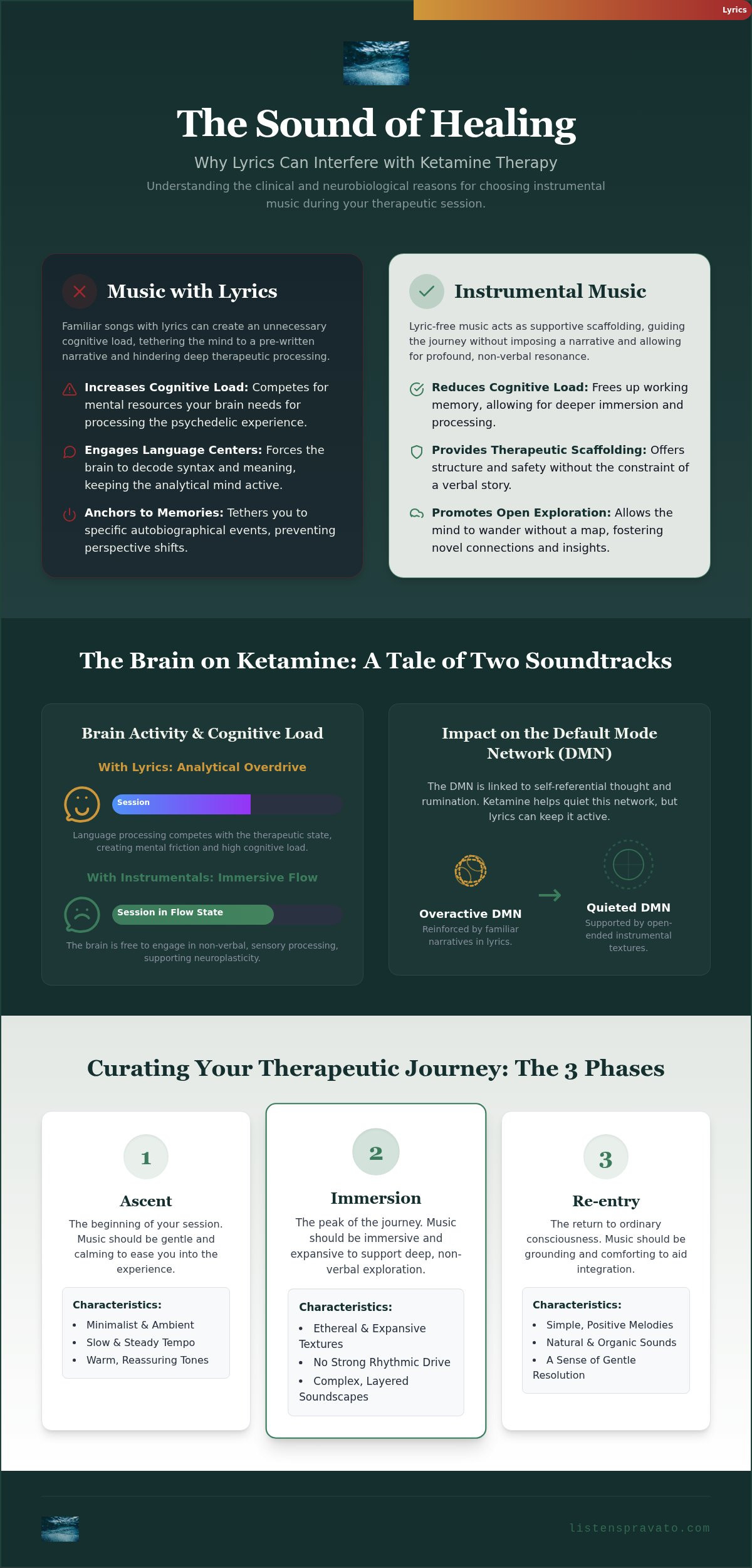
Cognitive load refers to the total amount of mental effort used by your working memory. During a Spravato® or ketamine session, your brain is already working at a high capacity to process profound sensory shifts. Lyrics add a demanding layer of complexity. They force your brain to decode syntax, interpret meaning, and track a verbal narrative. This creates a competition for internal resources. Instead of entering a state of therapeutic immersion, your mind stays occupied with the "work" of language. You're effectively asking your brain to read a book while it's trying to dream.
The Trap of Familiarity
Familiar songs are often tied to concrete, autobiographical memories. A specific lyric might whisk you back to a difficult breakup or a specific period of your childhood. While these memories are meaningful, they act as emotional anchors. They tether you to your ego and your personal history at the exact moment you're trying to find perspective outside of them. The goal of the session is to move beyond these rigid mental structures. When your brain is busy analyzing a singer's story, it lacks the space for the unstructured, abstract thinking that leads to breakthroughs. You don't want to over-intellectualize the experience; you want to live it.
Breaking the Narrative
Ketamine's primary therapeutic goal is to quiet the internal narrative, not reinforce it. Lyrics present a pre-written story that your brain feels biologically compelled to follow. This creates a guided path where there should be an open horizon. Instrumental textures offer an open-endedness that allows your mind to wander without a map. By removing the human voice, you remove the social and linguistic pressure to "understand" another person's perspective. This intentional absence of language is what allows your own internal resonance to surface. It provides the freedom required for the brain to reorganize itself without the interference of a scripted story.
The Neuroscience of Language During Ketamine Dissociation
The brain possesses specialized architecture for language, primarily located in Broca’s and Wernicke’s areas. Broca’s area manages the production of speech, while Wernicke’s area is responsible for its comprehension. During a state of dissociation induced by esketamine or ketamine, these regions remain vigilant. When lyrics enter the auditory field, these areas are biologically recruited to decode syntax and semantic meaning. This creates a state of "mental friction." Your brain is attempting to expand into a non-linear, sensory state, yet it is simultaneously forced to perform the rigid, analytical task of linguistic processing.
This competition for resources occurs between the prefrontal cortex and the sensory systems. The prefrontal cortex is the seat of our analytical mind; it's the part of us that tries to make sense of things. Ketamine aims to soften this analytical grip. By choosing instrumental music, you allow the brain to bypass these linguistic toll booths, reaching the emotional core of the experience directly. This is a primary reason why no lyrics during ketamine infusion is recommended by many experienced providers. It prevents the brain from getting stuck in an "interpretive loop" that can stall the therapeutic process.
Language and the Default Mode Network (DMN)
The Default Mode Network is a collection of brain regions associated with self-referential thought, rumination, and our sense of "ego." In many mental health conditions, this network is overactive, keeping us trapped in repetitive, negative thought patterns. One of the most profound benefits of ketamine is its ability to temporarily quiet the DMN, allowing for a perspective shift. Lyrics, by their very nature, are often self-referential or narrative-driven. They invite the DMN to stay active, anchoring you to the very "self" you are trying to transcend. Lyric-free sound facilitates DMN suppression by removing the narrative hooks that keep the analytical mind engaged.
The Sensory Shift
Ketamine often induces a state of synesthesia, where the boundaries between senses blur. You might "see" the music or "feel" the architecture of a sound. Language is a precise, limiting tool that tends to "flatten" this multi-sensory potential. It forces an abstract experience into a concrete box. Purely vibrational sound, however, allows for a more expansive internal landscape. It respects the biological shift occurring within your neural pathways. To better understand how to navigate these sensory choices, you might find it helpful to explore the curated protocols in Listening to Spravato, which offers a deeper look at the interplay between sound and healing.
Lyrics as Anchors vs. Instrumental Music as Scaffolding
In the delicate architecture of a psychedelic session, sound serves two distinct roles: it can either be an anchor or scaffolding. An anchor, like a lyrical song, tethers you to a specific meaning, a set time, or a defined emotion. It holds you in place. Scaffolding, conversely, supports the weight of the experience while allowing you to climb higher. This is the core reason why no lyrics during ketamine infusion is so often recommended. Instrumental music provides a steady rail to hold onto, offering a sense of direction without forcing a specific destination.
When you are in a state of deep dissociation, your sense of self and surroundings often softens. In this space, the predictability of non-verbal sonic structures offers a unique form of psychological safety. You aren't being asked to follow a story; you are being supported by a frequency. This allows you to explore the internal landscape with the confidence that the music will remain a consistent, reliable boundary. It provides the structure needed to navigate the unknown without the weight of a verbal narrative.
The Weight of the Human Voice
Humans are evolutionarily biased toward the sound of a voice. We are hardwired to prioritize speech because, for thousands of years, it signaled either danger or social connection. During a session, this biological "gravity" can become a burden. Even a soothing voice can feel intrusive, pulling you out of an expansive state and back into a social or analytical mode. Many patients report an "uncanny valley" effect, where hearing a human voice while in a non-ordinary state feels strangely misplaced or jarring. It disrupts the sanctity of the internal journey by introducing a social presence where there should be pure introspection.
Building a Safe Container
Creating a safe container involves more than just silence. It requires carefully selected timbre and texture to build a sense of physical space within the mind. Using music for spravato treatment acts as a protective boundary, ensuring that the external world doesn't bleed into your internal work. Timbre, the "color" of the sound, can feel like a warm blanket or a vast cathedral, providing a sensory environment that respects the gravity of the medicine.
To maintain this container, long-form tracks are essential. The sudden transition between three-minute radio songs can feel like a physical jolt to the nervous system. By choosing extended compositions, you avoid the jar of song transitions, allowing the medicine to work within a seamless, uninterrupted flow of sound. This methodical approach to curation ensures that the music remains a facilitator of healing rather than a distraction.
How to Choose Lyric-Free Music for Your Next Session
Selecting the right auditory environment requires a shift in perspective. You aren't simply looking for background music; you are choosing the emotional weather for your journey. Instead of focusing on a specific genre like classical or ambient, evaluate potential tracks based on their emotional valence. This term refers to the intrinsic "feeling" of the music. Does it feel expansive and hopeful, or does it feel heavy and restrictive? This is another reason why no lyrics during ketamine infusion is so important. You need a blank canvas where your own emotions can breathe without the influence of a singer's specific intent.
Phase-Specific Selection
A typical Spravato® session follows a reliable three-phase structure. Your music should mirror this biological arc to provide the best support. During the onset phase, which lasts roughly the first fifteen to twenty minutes, choose music that is warm and inviting. It should act as a gentle invitation into the experience, easing the transition from the busy outside world into the state of dissociation.
The peak phase requires expansive, atmospheric soundscapes. These tracks should feel vast, providing enough space for the deepest internal work to unfold. Finally, as you move into the integration phase, shift toward grounding, rhythmic music. This integration phase music ketamine process helps you slowly re-orient to your body and the physical room, providing a sense of stability as the medicine's primary effects begin to wane.
What to Avoid in Instrumental Music
Not all instrumental music is created equal. Ketamine significantly heightens your sensitivity to sound, making sharp, percussive noises feel like physical jolts to the nervous system. Avoid tracks with sudden volume changes or erratic rhythms that might trigger a startle response. While New Age music is a common choice, be wary of cliches that might feel overly saccharine or "forced." You want music that feels authentic and resonant, not generic.
Be mindful of "hidden" lyrics. Many ambient or world music tracks utilize vocal chops, chants, or distant whispers. Even if you can't understand the words, your brain's language centers may still attempt to decode these sounds. This can create the same cognitive friction as a pop song. Before you step into the clinic, test your playlist at home. Listen to the first few minutes of each track to ensure the atmosphere is consistent and free of linguistic distractions. To simplify this process and ensure your session is supported by professional expertise, you can explore our curated protocols designed specifically for the esketamine experience.
The Learned Guide: Mastering Sound with 'Listening to Spravato'
Navigating the nuances of therapeutic sound can feel overwhelming without a structured framework. While the clinical reasons for why no lyrics during ketamine infusion are grounded in neuroscience, applying that knowledge in a clinic setting requires a different kind of expertise. This is where the Listening to Spravato guide serves as an essential bridge. It translates complex auditory theory into a practical, compassionate roadmap for your healing journey. By bridging the gap between the clinical and the artistic, this resource helps you transform a medical appointment into a deeply personal ritual of restoration.
The value of this resource lies in its unique authorship. Written by a conservatory-trained musician who is also a patient, the guide offers a perspective that is both technically precise and deeply empathetic. It doesn't just tell you what to listen to; it explains how sound interacts with your nervous system. By understanding the intentionality behind every sonic choice, you're empowered to become an active participant in your treatment rather than a passive recipient. This dual perspective ensures that the music you choose isn't just "pleasant," but is biologically optimized for the work at hand.
A Resource for the Modern Patient
The listening to spravato book provides genre-by-genre music protocols designed to match the specific phases of your session. Whether you prefer ambient textures, modern classical, or minimalist electronics, the guide helps you identify tracks that respect the biological needs of the brain during dissociation. Having a physical or digital reference allows you to refine your sensory environment over a series of treatments. The audiobook edition is particularly effective for this process. It allows you to hear the subtle differences between supportive and disruptive soundscapes, providing an immersive learning experience that prepares you for the internal journey.
Taking the Next Step
Preparing for your next session involves more than just a playlist. It's about creating a comprehensive "kit" that includes high-quality noise-canceling headphones, a comfortable eye mask, and the confidence to advocate for your needs. Use the insights from the guide to discuss your music choices with your provider. Most clinicians appreciate patients who take an intentional approach to their set and setting. It shows a commitment to the process that can deepen the therapeutic alliance.
Your ears are the doorway to your internal landscape. By choosing to listen with intention, you're giving yourself the best possible chance to maximize the neuroplastic benefits of your session. Trust in the structure you've built. Allow the music to be your scaffold, and step into your next treatment with a sense of quiet, prepared confidence. Your journey toward healing is a masterpiece in progress, and sound is the brush you use to paint it.
Elevating Your Healing Through Intentional Sound
Choosing the right auditory landscape is an act of self-care that directly influences the success of your session. You now understand that the brain's language centers and the state of dissociation are biologically at odds. By respecting the clinical necessity of why no lyrics during ketamine infusion, you remove unnecessary cognitive friction and allow your mind to explore its new neural pathways without interference. Instrumental music isn't just a background choice; it's the scaffolding that supports your deepest breakthroughs.
To master these sensory choices, consider the expertise of a conservatory-trained musician and patient. Listening to Spravato® is used by clinics worldwide to improve patient outcomes and is available in print, digital, and immersive audiobook formats. It provides the genre-specific protocols you need to navigate every phase of your treatment with confidence. This resource empowers you to transform a medical requirement into a curated, artistic experience of healing.
Order 'Listening to Spravato' on Amazon or your favorite retailer to begin curating a more resonant, effective therapeutic experience. Your journey toward clarity deserves a soundtrack that honors the depth of your work.
Frequently Asked Questions
Is it okay to listen to music with lyrics if it's in a language I don't understand?
Even if you don't understand the words, your brain's auditory cortex still identifies the human voice as a primary signal. It will attempt to decode phonemes and emotional inflections, which keeps your analytical centers engaged. This is why no lyrics during ketamine infusion is the standard, regardless of the language. You want to avoid any stimulus that forces the brain into a decoding mode, allowing it to remain in a state of pure resonance.
What happens if a song with lyrics accidentally plays during my infusion?
If a song with lyrics begins to play, simply acknowledge it and skip to the next track with a sense of calm. The anxiety of feeling you've "ruined" the session is often more disruptive than the song itself. Your brain is highly suggestible in this state, so treat the moment with grace. Once the instrumental music returns, focus on your breath and allow the sonic scaffolding to guide you back into immersion.
Can I use 'nature sounds' instead of instrumental music for my Spravato session?
Nature sounds can be grounding, but they often lack the rhythmic and harmonic structure required to provide therapeutic scaffolding. While a recording of rainfall is pleasant, it doesn't offer a "pathway" for the mind to follow during deep dissociation. Instrumental music, particularly when curated with intentionality, provides a more reliable container. It helps you navigate the peak of the experience by offering a consistent, predictable flow that nature sounds often lack.
Why do some people recommend classical music for ketamine therapy?
Classical music is often recommended because it offers a sophisticated level of emotional depth without the distraction of a verbal narrative. Many patients find that the complex textures of a string quartet or solo piano provide a rich landscape for internal exploration. However, it's vital to avoid pieces with sudden, jarring volume changes or aggressive crescendos. Look for modern classical or minimalist compositions that maintain a steady, supportive atmosphere throughout the entire piece.
How loud should my music be during the ketamine treatment?
Your music should be loud enough to create a "sonic cocoon." It needs to mask clinic noises like hallway conversations or equipment hums. However, it shouldn't be so loud that it feels intrusive or physically uncomfortable. A moderate volume allows the sound to feel like it's happening "within" you rather than "at" you. Finding this balance ensures the music remains a supportive facilitator of your journey rather than a source of sensory overwhelm.
Are there any exceptions where lyrics might be helpful during integration?
Lyrics can be quite helpful during the final integration phase as you begin to re-orient to your daily life. At this stage, a song with meaningful words can act as a bridge. It helps you reconnect with your personal story and identity after the expansive state of dissociation. While the peak of the experience requires a non-verbal environment, the "come down" period is a beautiful time to introduce music that resonates with your values.
What is the best genre of lyric-free music for beginners?
Ambient music is often the best starting point for those new to esketamine or ketamine therapy. It's characterized by its lack of a strong, driving beat and its focus on atmosphere and texture. This open-ended quality makes it perfect for those who are still learning why no lyrics during ketamine infusion is beneficial. It provides a soft, safe environment that doesn't demand anything from the listener, allowing the medicine to take center stage.
Does the type of headphones I use matter for a lyric-free experience?
The type of headphones you use significantly impacts your ability to maintain an immersive experience. High-quality, over-ear headphones with active noise cancellation are the gold standard. They provide the physical isolation needed to keep your focus internal while ensuring the music's full frequency range is delivered clearly. Comfort is also a key factor, as you'll be wearing them for an extended period. Avoid earbuds that might slip out or cause pressure points.


