

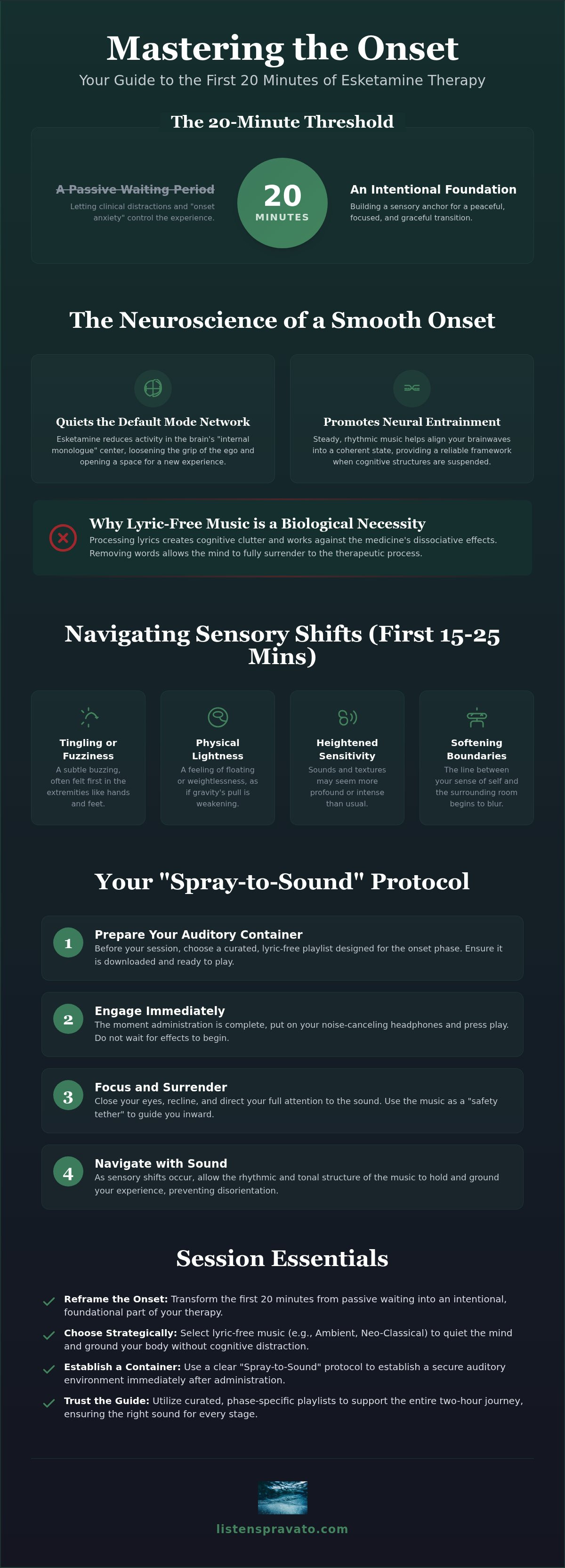
The first twenty minutes of an esketamine session are often treated as a mere waiting period, yet they represent the most delicate threshold of the entire therapeutic journey. It's during this window that the mind begins its departure from the physical world, navigating the space between clinical reality and the dissociative state. When you prioritize the selection of spravato onset phase music, you're not just choosing a background track; you're constructing a sensory anchor that prevents the transition from feeling jarring or filled with "onset anxiety."
You've likely felt the tension that builds while waiting for the medicine to take effect as the clinical environment hums around you. It's difficult to let go when every distant footstep or beep of a monitor pulls you back to the room. We'll show you how to build a safe, lyric-free container that facilitates a graceful descent into your internal experience. This guide provides a clear protocol for those first twenty minutes, ensuring you have the tools to silence the noise and master the transition into a peaceful, focused session.
Key Takeaways
- Reframing the first 20 minutes from a passive waiting period into an intentional foundation for your entire therapeutic session.
- How strategically chosen spravato onset phase music facilitates neural entrainment and quiets the Default Mode Network for a smoother transition.
- Why lyric-free genres like Ambient and Neo-Classical provide the necessary emotional grounding without causing cognitive distraction.
- A step-by-step "Spray-to-Sound" protocol to help you establish a secure auditory container immediately following administration.
- The role of the Listening to Spravato guide in providing curated, phase-specific playlists that support the entire two-hour journey.
Understanding the Spravato Onset Phase: The First 20 Minutes
The onset phase is far more than a clinical observation period; it's the psychological bridge between the sterile environment of the clinic and the expansive landscape of your internal experience. For most patients, these first twenty minutes represent the most vulnerable window of the entire session. You've finished the active process of administration and now must wait for the medicine to take hold. This transition from active doing to passive reception often triggers "pre-flight" anxiety if the mind isn't given a clear direction.
During this threshold, your brain begins to process the medication. This Esketamine overview explains how the compound acts as a dissociative anesthetic, which fundamentally alters your perception of reality. As the ego begins to loosen its grip, the mind naturally searches for anchors. Without a structured auditory environment, your focus may latch onto clinical distractions, such as the hum of an air conditioner or distant hallway chatter. Utilizing intentional spravato onset phase music provides a "safety tether," offering the brain a consistent, non-threatening structure to follow as external reality begins to recede.
The Psychology of the Launch
Managing the transition from the external world requires a shift in intentionality. When you're sitting in a medical office, your sympathetic nervous system is often on high alert, scanning for potential stressors. Environmental noises can easily trigger a "fight or flight" response during this delicate time. By choosing audio that feels both sophisticated and grounding, you establish a sense of personal dignity within the clinical setting. It's about moving from a state of being "monitored" to a state of being "held." Your music choice signals to your nervous system that the environment is secure, allowing you to surrender to the process with quiet confidence.
Duration and Sensory Shifts
Clinical consensus indicates that the onset phase typically lasts between 15 and 25 minutes. During this window, you'll experience a series of predictable physiological shifts. These often include:
- A subtle tingling or "fuzziness" in the extremities.
- A feeling of physical lightness or floating.
- Heightened sensitivity to textures and sounds.
- A gradual softening of the boundaries between the self and the room.
It's helpful to view this time as an "Active Preparation Period" rather than a passive waiting room. As the sensory changes begin, the rhythmic pulses of your spravato onset phase music act as a guide, helping you navigate the initial loss of ego control. By the time the medicine reaches its peak, the music has already built the container you need to feel safe in the deep dissociative state.
The Neuroscience of Sound: Why Music Structure Matters for Onset
Esketamine fundamentally shifts how the brain organizes information. As the medication begins to take effect, it quiets the Default Mode Network (DMN), the neural system responsible for our sense of self and continuous internal monologue. This biological un-tethering creates a space where external sensory input becomes the primary guide for the internal experience. Choosing the right spravato onset phase music is essential because it leverages a concept known as neural entrainment. By providing steady, rhythmic pulses, music helps align brainwaves into a state of coherence, offering a reliable framework while the usual cognitive structures are temporarily suspended.
The brain requires predictability during this transition. As dissociation begins, the relationship between sound resonance and the physical body becomes more pronounced. Low-frequency vibrations aren't just heard; they're felt as a grounding weight that prevents the sensation of floating from becoming disorienting. Using sound as a structural map allows the mind to stay anchored even when visual input begins to blur or lose its meaning.
Quieting the Language Center
The cognitive load of decoding semantic meaning is remarkably high. While esketamine is working to expand consciousness, the brain’s language center is often one of the first areas to experience a shift in function. Trying to process lyrics during this time forces the mind to work against the medicine’s natural flow, creating a sense of confusion or mental clutter. Lyric-free music is a biological necessity during the onset phase because the brain’s linguistic processing centers are temporarily compromised by the medication’s dissociative effects. Removing the need to "decode" words allows the mind to focus entirely on the therapeutic process.
Building the Auditory Container
A successful onset phase relies on the quality of the soundscape, specifically how your spravato onset phase music utilizes resonance to ground the body. You should prioritize warm sounds, such as soft ambient pads or deep cello tones, which feel inclusive and supportive. Sharp or high-pitched electronic sounds can feel piercing or intrusive as your sensory sensitivity increases. Low-frequency drones act as a floor for the experience, grounding the physical body while the mind explores new territory. This auditory container provides the necessary safety to let go. For those looking to refine their selection, the Listening to Spravato guide offers deeper insights into how specific acoustic structures support the brain during treatment.
Selecting the Right Genres for the Onset Phase
Choosing the right genre for the first twenty minutes requires a shift in perspective. While peak-phase music can be expansive and emotionally challenging, spravato onset phase music must prioritize safety and non-threatening stability. You aren't looking for a performance; you're looking for a container. The goal is to provide a soundscape that supports the nervous system as it prepares to let go of external ego structures.
Ambient music stands as the gold standard for this transition. Its lack of a traditional song structure prevents the brain from trying to predict the next "hook" or chorus. This allows the mind to remain in a state of calm receptivity. Similarly, Neo-Classical compositions featuring soft, sustained strings provide a sense of emotional grounding. Unlike complex orchestral works, which can feel overwhelming as your sensory processing changes, minimalist strings offer a warm, human element that feels supportive rather than demanding.
Nature sounds can also be effective, provided they are organic. High-quality recordings of rain or distant ocean waves feel familiar to the biological mind. You should avoid synthesized nature sounds, as the repetitive, digital loops can become apparent and distracting as your hearing becomes more acute during the onset. It's equally important to know what to avoid. Jazz, for instance, often relies on syncopation and unexpected melodic shifts. While beautiful in a standard setting, these "surprises" can feel like sharp intrusions during the onset of dissociation. Complex classical music with high-frequency "stabs" or sudden volume changes should also be set aside, as they can trigger a startle response.
Ambient and Minimalist Textures
Minimalist textures excel because they often have no distinct beginning or end. These "washy" soundscapes mirror the way physical boundaries begin to blur during the first stage of treatment. By prioritizing space over melody, artists in this genre allow your thoughts to drift without being tethered to a specific musical narrative. This openness is crucial for a graceful descent into the session. It creates an environment where the music doesn't demand your attention but instead waits patiently for you to lean into it.
The Role of Rhythmic Pulses
A slow, steady pulse is a powerful tool for stabilization. Aim for music with a tempo of 60 to 80 beats per minute, which mimics a resting human heart rate. This subtle rhythm provides a sense of continuity, preventing the feeling of "floating away" too quickly before you're ready. In a therapeutic context, a "pulse" is a soft, felt vibration, whereas a "beat" is a sharp, percussive hit. The former grounds you; the latter can be jarring. Finding the right spravato onset phase music means looking for these low-frequency pulses that act as a heartbeat for your journey, keeping you connected to a sense of safety even as your perception shifts.
A Step-by-Step Onset Protocol for Patients
Establishing a personal ritual before your session transforms a clinical procedure into a mindful journey. Your preparation begins well before the first spray. Start by curating your spravato onset phase music and testing your audio levels in a quiet environment. During the actual appointment, the "Spray-to-Sound" transition is a vital moment. You should hit play immediately after your final dose of the nasal spray. This timing ensures the auditory container is fully formed before the first sensory shifts begin to manifest.
Pair this opening track with intentional, mindful breathing. Focus on slow, diaphragmatic exhales to signal safety to your nervous system. As you settle into the clinic chair, adjust your environment by donning an eye mask and reclining. This physical act of letting go of your device and the external room allows you to move from an active participant to a receptive observer. By the time the medicine begins to peak, you've already established a rhythm of surrender.
Audio Gear and Setup
Isolation is paramount in a clinical setting. Noise-canceling headphones are generally superior to open-back designs because they provide a necessary barrier against unpredictable clinic noises like hallway chatter or equipment hums. Aim for a "Goldilocks" volume level; it must be loud enough to mask the environment but quiet enough to feel gentle and non-threatening. Ensure your cables are tucked away and your device is placed where it won't be bumped. Once the medicine takes effect, even small physical disruptions can feel magnified and distracting.
The Ritual of Surrender
Setting a simple, open-ended intention during the first track helps focus the mind without creating rigid expectations. Use the music as a guide for a brief body scan. Starting at your toes, consciously relax each muscle group in time with the rhythmic pulses of the track. This process grounds your physical body while your mind begins to drift. As the 20-minute mark approaches, you'll need to transition to your peak-phase audio. If your player supports it, a 10-second crossfade creates a seamless bridge into the deeper dissociative experience. For a complete walkthrough of these transitions, you can find the structured protocols in the Listening to Spravato guide.
Deepening Your Experience with the Listening to Spravato Guide
The "Listening to Spravato" book serves as the definitive architecture for your session. While we've focused here on the first twenty minutes, the full treatment window lasts two hours, requiring a carefully paced auditory narrative that evolves with the medicine. Author Justin Page, a conservatory-trained musician and patient, bridges the gap between clinical necessity and artistic resonance. By utilizing the phase-specific protocols found in the guide, you can ensure your spravato onset phase music transitions seamlessly into the deeper layers of the dissociative experience.
The audiobook edition offers a particularly immersive way to prepare for your treatment. It allows you to hear the music references and structural explanations while you're in the comfort of your home, far from the clinical environment. This pre-session immersion helps demystify the sensory shifts you'll later encounter. Using the genre-by-genre guides, you can tailor your selection to your personal aesthetic while remaining within the "no-lyrics" framework that is essential for maintaining a safe, focused container.
A Companion for the Journey
Having a peer-authored resource reduces the inherent anxiety of the unknown. The guide adopts a "Learned Guide" approach, offering specialized knowledge delivered with the warmth of someone who has walked the path. This perspective is invaluable when you need to communicate your sensory needs to your clinician. It provides a shared vocabulary for discussing volume, lighting, and the importance of an undisturbed auditory environment. A physical guide also offers a sense of grounding; holding a book before your session begins provides a tactile anchor that digital devices simply cannot replicate.
Beyond the text, the guide provides direct access to curated playlists on Spotify and Apple Music. These are meticulously structured to follow the biological arc of the medication. Starting with the grounding pulses of your spravato onset phase music, these collections move through the expansive peak and into the gentle resolution of the integration phase.
Next Steps: Beyond the First 20 Minutes
The transition into the Peak phase, described in the guide as the "Dissociative Deep Dive," requires a shift toward more complex, non-linear soundscapes. The book explains how to navigate this peak intensity without losing your sense of safety. Finally, the integration phase uses music to help you "come back" to the room, providing a soft landing as the dissociative effects begin to wane. To fully prepare for every stage of your treatment, you can order the Listening to Spravato book or audiobook to master your session protocols.
Mastering the Threshold of Your Journey
The first twenty minutes of your treatment don't have to be a source of apprehension. By intentionally selecting spravato onset phase music, you transform a clinical waiting period into a dignified foundation for healing. We've explored how lyric-free, predictable sound structures protect the brain's language center while grounding the body through low-frequency resonance. This methodical approach ensures that your transition into dissociation is a graceful descent rather than a jarring shift.
True mastery of this experience comes from bridging the gap between clinical science and the art of sound. To move beyond the basics and access comprehensive, phase-specific protocols, you can Enhance your healing journey with the Listening to Spravato® Book and Audiobook. Written by a conservatory-trained musician and patient, and endorsed by leading Spravato clinicians, this resource is available globally in Print, Digital, and Audiobook formats. You possess the agency to shape your environment. With the right tools and a curated soundscape, you can step into every session with quiet confidence and a sense of profound purpose.
Frequently Asked Questions
Why can’t I listen to music with lyrics during the Spravato onset phase?
Lyrics engage the brain's language center, which creates an unnecessary cognitive load while the medication is trying to quiet the Default Mode Network. Processing semantic meaning forces your mind to remain tethered to external concepts. Instrumental music allows for a more expansive internal experience. By removing words, you give your consciousness the space it needs to transition into a dissociative state without the distraction of verbal narratives.
How loud should my music be during the first 20 minutes of treatment?
You should aim for a moderate volume that feels like a gentle embrace. It needs to be loud enough to mask ambient clinic noises, such as distant conversations or machine hums, but quiet enough to avoid being piercing. As the esketamine takes effect, your sensory sensitivity often increases. A volume level that feels perfect at home might feel overwhelming in the clinic, so be prepared to make subtle adjustments.
Should I start my music before or after I take the Spravato nasal spray?
It is best to hit play immediately after your final dose of the nasal spray. This "Spray-to-Sound" transition ensures that your auditory container is fully established before the first physiological shifts begin. Starting your spravato onset phase music at this exact moment helps manage pre-administration jitters. It signals to your nervous system that the active work is finished and the period of receptive healing has officially begun.
What happens if my music stops or my headphones die during the onset phase?
Sudden silence can feel jarring during the transition, but it is not a medical emergency. If your audio fails, focus on slow, diaphragmatic breathing to maintain your sense of calm. Use the silence as a neutral space to observe your internal state without judgment. To prevent this, always ensure your devices are fully charged and your playlists are downloaded for offline use to avoid any streaming interruptions.
Can I use guided meditation instead of music for the Spravato onset?
Guided meditation is generally discouraged during the first twenty minutes because the narrator's voice acts much like song lyrics. The brain's linguistic processing centers are often compromised by the medication, making it difficult to follow verbal instructions. Purely instrumental soundscapes or organic nature sounds provide a more supportive environment. They allow you to surrender to the experience rather than trying to decode a guide's specific words or directions.
Is it better to use noise-canceling headphones or earbuds for my session?
Noise-canceling headphones are the superior choice for most patients in a clinical setting. They provide a robust electronic and physical barrier against unpredictable office sounds. The over-ear design also creates a sense of "enclosure" that many find grounding as they begin to lose ego control. Ensure your chosen pair is comfortable for long-term wear, as you will be reclining for the full two-hour monitoring period.
What are the best genres for someone who doesn’t like ambient music?
Neo-Classical and minimalist solo instrumental works are excellent alternatives to ambient textures. These genres provide emotional grounding through soft strings or piano without the jarring complexity of a full orchestra. When selecting your spravato onset phase music, look for tracks with a steady, slow tempo of 60 to 80 beats per minute. This rhythmic pulse mimics a resting heart rate, providing a reliable anchor while your perception of the room shifts.
How do I explain my music choice to my Spravato provider?
You can explain to your provider that you are using a structured auditory protocol to manage onset anxiety and facilitate a smoother transition into dissociation. Mention that you are following a "no-lyrics" rule to reduce cognitive load during the most vulnerable window of the session. Sharing that your preparation is based on the Listening to Spravato guide helps your clinician understand that your audio choices are an intentional part of your therapeutic process.


