

What if the primary obstacle between you and relief isn't the treatment itself, but the intimidating silence of the unknown? It's common to feel a flicker of anxiety when you consider esketamine, especially when trying to understand what does ketamine feel like in a clinical setting. You may find yourself caught between the clinical coldness of medical brochures and the chaotic stories of recreational misuse. This confusion is understandable; however, the therapeutic Spravato experience is a fundamentally different territory, one defined by structure, safety, and mindful facilitation.
In this sensory guide, we'll demystify the physical, emotional, and internal stages of a therapeutic session. You'll discover how the medicine moves through your body and mind, shifting from a quiet onset into a deeper, more resonant state. By understanding these nuances, you'll gain the tools to navigate the experience with confidence. We'll explore the specific rhythms of a session and provide practical strategies to steer your journey if it feels intense. Our goal is to replace uncertainty with a sense of prepared dignity, allowing you to approach your healing with a steady heart and an informed mind.
Key Takeaways
- Recognize the subtle transition into therapeutic dissociation, where the body feels both grounded and buoyant during the initial twenty minutes.
- Gain clarity on what does ketamine feel like during the peak of a session, including the emergence of geometric visual landscapes and the phenomenon of time dilation.
- Understand the "emotional anesthesia" that allows for a compassionate re-parenting of oneself and the processing of trauma with a sense of safety.
- Learn how to use music as a rhythmic container to facilitate transitions between different internal states and sensory experiences.
- Discover how to cultivate a supportive mindset and environment using curated tools that anchor your focus and enhance the therapeutic resonance of the treatment.
The Spectrum of Dissociation: What Does Ketamine Feel Like Initially?
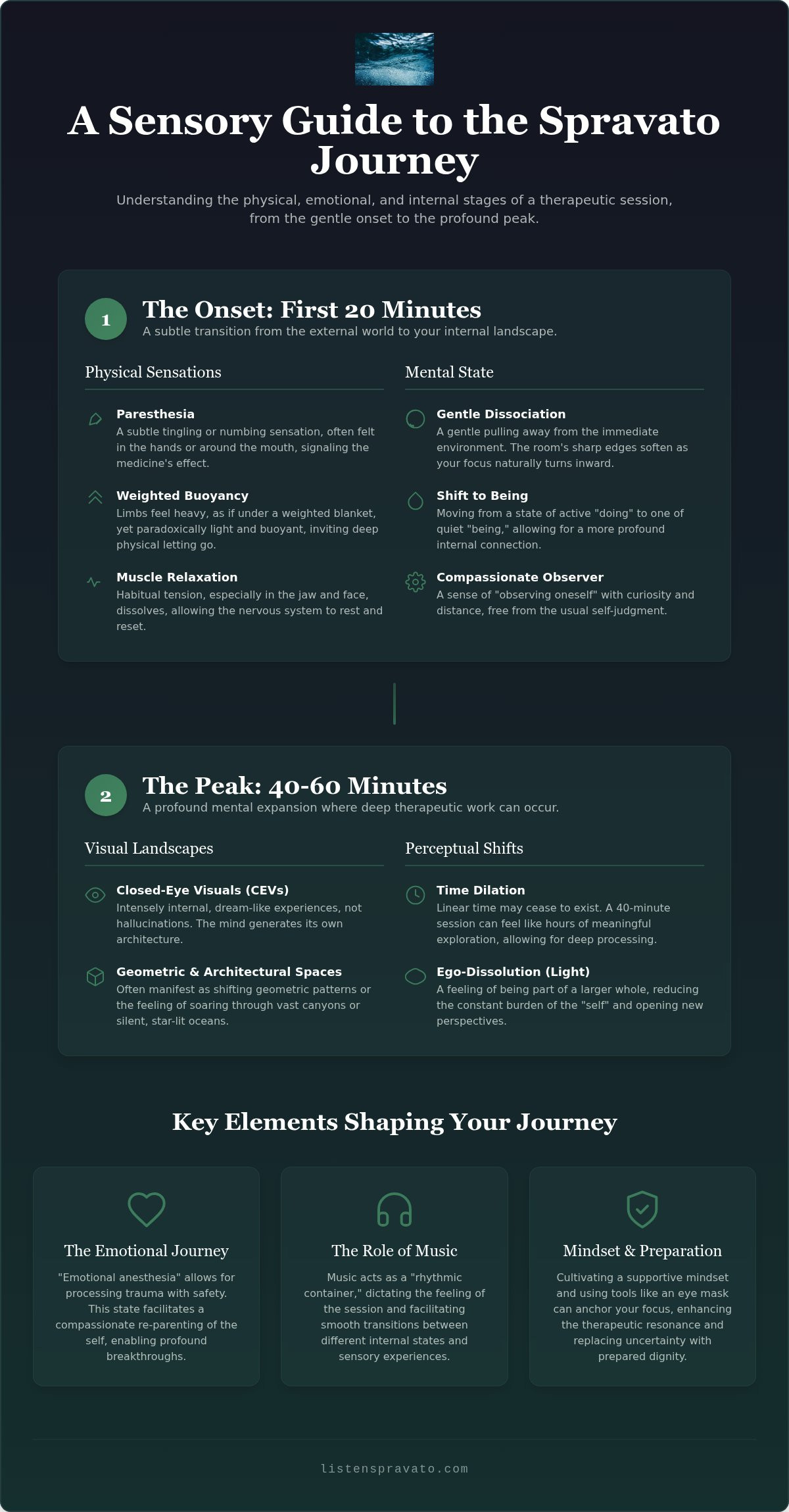
Dissociation is often misunderstood as a total loss of identity or consciousness. In a clinical setting, however, it's experienced as a gentle pulling away from the immediate environment. You remain present, yet the sharp edges of the room begin to blur. This shift allows you to move from a state of active doing to one of quiet being. For a comprehensive overview of ketamine and its pharmacological profile, one can see how it acts as an NMDA receptor antagonist to facilitate this unique mental space. Understanding what does ketamine feel like begins with recognizing this subtle transition from the external world to the internal landscape.
The onset phase usually occurs within the first 20 minutes of administration. You might notice paresthesia, a subtle tingling or numbing sensation in the hands or around the mouth. This is the body’s first signal that the medicine is taking effect. It's not a loss of control; it's a deepening of relaxation. Many patients find that the common fear of "losing oneself" is replaced by the reality of "observing oneself." You're granted a compassionate distance from your own thoughts, viewing them with curiosity rather than judgment.
The Physical Weight of Calm
As the session deepens, your limbs may feel as though they're covered by a soft, weighted blanket. This density is paradoxically accompanied by a sense of buoyancy, creating a grounded yet light physical state. It's an invitation to let go of the physical armor we carry daily. You'll likely notice the muscles in your jaw and face dissolve their tension as the body surrenders its habitual stress. Dissociation is a functional disconnect between sensory input and emotional reactivity. This state allows the nervous system to rest while the mind remains alert and observant.
The Onset: From Room to Inner Space
The clinic room walls seem to soften during the first few minutes. They become less relevant as your focus naturally turns inward. This is the moment to close your eyes and lean into the emerging imagery. The first 20 minutes are critical because they set the emotional tone for the peak. If you enter this phase with mindful intentionality, the subsequent experience feels more like a structured journey than a random event. Transitioning from external focus to internal "closed-eye" imagery marks the true beginning of the therapeutic work, where the mind starts to process information in a more fluid, less rigid way. Knowing what does ketamine feel like in these early moments helps you settle into the experience with a sense of safety and purpose.
Navigating the Peak: Sensory Shifts and Visual Landscapes
The peak of a Spravato session is often described as a suspension of the ordinary. It's the period where the medicine’s influence is most profound, typically lasting between forty and sixty minutes. Unlike traditional hallucinations that overlay onto the physical world, these experiences are intensely internal and dream-like. You remain aware that you're in a clinic, yet your primary focus shifts to a vivid, internal landscape. Ketamine's dissociative effects create a state where the mind is free to explore without the usual constraints of the ego. This is often where people truly discover what does ketamine feel like, as the sensation moves from a physical heaviness to a profound mental expansion.
Visuals: Beyond the Eyes
When you eliminate external light with a high-quality eye mask, the mind begins to generate its own architecture. These closed-eye visuals (CEVs) are rarely random. They often manifest as shifting geometric patterns or vast, echoing architectural spaces. You might feel as though you're soaring through a canyon or drifting across a silent, star-lit ocean. These movements feel meaningful; they aren't just neurological noise. They represent the brain’s attempt to organize a state of heightened neuroplasticity. The "movement" within these landscapes provides a sense of progress, as if you're traveling through the layers of your own consciousness. This visual journey is a hallmark of the peak phase.
The Distortion of Time and Space
Linear time often ceases to exist during the peak. A forty-minute session can feel like hours of exploration, a phenomenon known as time dilation. This can be intimidating if you aren't prepared, but it's also where deep healing occurs. It allows for a "light" version of ego-dissolution, a feeling of being part of a larger whole without the constant burden of the "self." You may feel as though your mind has become a vast cathedral, spacious and quiet. Understanding what does ketamine feel like during these shifts is easier when you have a map for the territory.
If the intensity of this spatial expansion becomes overwhelming, your breath serves as the ultimate anchor. Focusing on the steady rhythm of inhalation and exhalation reminds you of your physical presence. For those seeking a structured way to navigate these sensory peaks, the audiobook edition of Listening to Spravato provides a calming, sensory-aligned companion to help you stay grounded. This preparation ensures that the distortion of time feels like an opportunity for depth rather than a loss of control. It transforms a potentially confusing experience into a structured path toward resonance and clarity.
The Emotional Journey: From Numbness to Breakthrough
The emotional landscape of a Spravato session is often where the most significant healing occurs. While the physical and visual shifts are striking, the internal emotional state provides the foundation for long-term change. Many people describe a state of "emotional anesthesia." This isn't a cold numbness; rather, it’s a protective buffer that allows you to engage with difficult thoughts without the usual surge of panic. When you explore what does ketamine feel like during these moments, you may find that complex life problems suddenly seem simple and solvable. This clarity arises because the medicine temporarily quietens the parts of the brain responsible for rumination and fear.
You might encounter "Aha!" moments where the solutions to long-standing personal conflicts become remarkably clear. These aren't forced realizations. They feel like a natural unveiling of truths that were previously obscured by the fog of depression. This state of mindful intentionality allows for a "re-parenting" feeling, a sudden surge of self-compassion or forgiveness. It's a moment of profound dignity where you can finally offer yourself the grace you've traditionally reserved for others. Understanding what does ketamine feel like in this context helps you prepare for a journey that is as much about the heart as it is about the mind.
Observing Without Reacting
During the session, ketamine effectively muffles the amygdala’s fear response. This creates a unique opportunity to visit difficult memories as if you're watching a movie from a comfortable distance. You aren't reliving the trauma; you're observing it with a newfound sense of curiosity. This functional distance is the key to ketamine’s anti-depressant effect. It allows the brain to reorganize its relationship with painful history. You're no longer a victim of the memory. Instead, you're an objective witness, capable of processing the past without being overwhelmed by its weight.
The Afterglow: Emotional Softness
The journey doesn't end when you leave the clinic chair. As the medicine wears off, you may feel a sense of vulnerability during the comedown. This is why a "safe container" is essential, a supportive environment where you can slowly reintegrate into the world. In the days following, many report a feeling of "lightness" or a "reset." This is the window of plasticity, a time when new habits and thoughts feel more accessible and less forced. To maximize this period, understanding the Spravato vs Ketamine Music Experience can help you maintain that sense of emotional softness through intentional soundscapes. This afterglow is a reminder that the breakthroughs of the session have real, lasting resonance in your daily life.
Why Music Dictates the 'Feeling' of Your Session
Music isn't just a background element; it's the architecture of the internal world. Ketamine induces a unique state of synesthesia where sound becomes a tangible, visual force. You might see the colors of a cello's vibration or feel the physical texture of a synth pad against your skin. This sensory blending is a defining part of what does ketamine feel like as you move through the profound depths of the session. A simple shift in tempo or key can be the difference between feeling "stuck" in a heavy emotion and "flowing" through a vast, open space. Sound acts as the invisible hand that guides your emotional momentum.
Sound as a Safety Tether
When the physical environment disappears, music provides the essential scaffolding for the mind. These familiar musical structures act as a safety tether, reminding you that you're supported even in the most intense states of dissociation. It's vital to choose instrumental tracks rather than music with vocals. Lyrics can often "tangle" the experience because language requires the analytical brain to remain engaged. This can trigger unnecessary anxiety or disrupt the fluid, dream-like nature of the journey. A successful session follows a specific narrative arc. You need a playlist that matches the quiet onset, the expansive peak, and the grounded integration phase. This methodology is a core component of the music protocols found in the Listening to Spravato book.
The Immersive Power of the Audiobook
Preparing for the sensory shift is just as important as the session itself. The "Listening to Spravato" audiobook uses sound to mirror the therapeutic journey, priming your brain for the "feeling" of the medicine before the first dose is administered. It offers the steady presence of a learned guide who speaks the language of both neuroscience and artistic resonance. This auditory preparation helps demystify the experience. It allows you to enter the clinic with a sense of quiet confidence. By understanding how sound dictates your internal state, you can actively influence the quality of your healing. To begin your preparation with expert-led soundscapes and protocols, you can access our curated Spravato playlists and resources today. This intentional approach ensures that your session remains a structured path toward clarity rather than a series of random sensations.
Preparing for the Unknown: How to Influence the Feeling
Preparation is the bridge between clinical administration and therapeutic breakthrough. While you cannot control the medicine’s chemical path, you can curate the environment in which it works. This is the "Set and Setting" framework. "Set" refers to your internal mindset, while "Setting" is the physical space around you. By approaching your treatment with mindful intentionality, you gain a degree of agency over the experience. Understanding what does ketamine feel like is much easier when you've prepared a stable, supportive container for the journey.
Practical tools are essential for a refined experience. High-quality, noise-canceling headphones aren't a luxury; they're a necessity to preserve the integrity of your internal world. Similarly, a contoured, light-blocking eye mask allows the mind to generate its own visual architecture without external interference. Before the session begins, engage in a brief intention-setting ritual. This isn't about forcing a specific outcome. It’s about giving the feeling a direction, such as "I am open to whatever arises" or "I seek clarity." This ritual provides a sense of purpose and dignity as you transition into the session.
Once the medicine begins to wane, the "Integration" phase begins. The insights gained during the peak can be fleeting, much like a dream upon waking. Carry a journal or art supplies to capture the resonance of the experience before it fades. Translating the internal feeling into words or color helps solidify the new neural pathways opened during the session, ensuring the experience has a lasting impact on your daily life.
The 24-Hour Preparation Window
The work begins long before you arrive at the clinic. Reducing sensory noise, such as social media or aggressive news cycles, creates a quiet mental space. Physical comfort is equally important. Maintain proper hydration and follow a light fasting protocol to prevent nausea, which can disrupt your focus. Most importantly, select your sonic environment carefully using the Music for Spravato protocols. This ensures your playlist acts as a supportive scaffold rather than a source of distraction, allowing you to settle into the medicine with confidence.
Navigating 'Turbulence'
Even with meticulous preparation, the intensity of the medicine can occasionally feel overwhelming. This is often described as "turbulence." If you find yourself questioning what does ketamine feel like when the experience becomes too vast, remember your anchors. Your breath is your most reliable physical tether. Deep, rhythmic breathing signals to your nervous system that you're safe. Lean into the music; let the melody carry the weight of the emotion. Remind yourself: "This is the medicine working, and I am safe." Your clinical observer is also present to provide a physical anchor if the internal landscape feels too expansive to navigate alone.
Stepping into the Resonant Space
Your journey through esketamine therapy is not a passive event; it's a meticulously structured exploration of the internal landscape. By moving from the gentle onset of dissociation into the expansive peak of visual and emotional clarity, you transform a clinical procedure into a profound personal narrative. Understanding what does ketamine feel like allows you to replace the anxiety of the unknown with a sense of prepared dignity. You now recognize that the emotional anesthesia and sensory shifts are not hurdles, but tools for deep psychological reorganization.
To truly master this experience, you need a map designed by someone who understands both the science of the brain and the art of the spirit. Endorsed by leading esketamine clinics, Listening to Spravato was authored by Justin Page, a conservatory-trained musician and patient who has walked this path himself. This guide is available in Print, Digital, and Audiobook formats to support your specific sensory needs. Ready to transform your session? Get the 'Listening to Spravato' guide on Amazon and approach your next treatment with the confidence of an informed traveler. Your path to resonance starts with the right preparation.
Frequently Asked Questions
Is the feeling of ketamine similar to being drunk?
The sensation is fundamentally different from alcohol consumption. While alcohol often leads to a loss of coordination and slurred focus, esketamine induces a state of lucid detachment. You don't feel "sloppy" or sedated in the traditional sense. Instead, you experience a peculiar buoyancy and mental clarity. This dissociative state allows you to observe your thoughts from a distance rather than being consumed by the physical heaviness associated with being drunk.
Can I control what I think about while I'm 'under'?
You can't strictly control the imagery, but you can certainly steer the emotional direction of the session. Setting a mindful intention beforehand acts as a compass for the mind. If you find yourself drifting into uncomfortable territory, you can use your breath or a change in the music to gently shift your focus. It's more about navigating a flowing river than trying to stop the water from moving.
What happens if I have a 'bad trip' during Spravato?
In a clinical setting, true "bad trips" are rare because of the controlled environment and lower therapeutic dosing. If the experience becomes intense or challenging, remember that you are in a safe container with professional supervision. These moments are often where the most significant emotional breakthroughs occur. Reminding yourself that the medicine is simply doing its work helps transform fear into a productive, albeit difficult, period of internal processing.
How long does the 'high' feeling last after the session?
The most intense part of the experience, often called the peak, typically lasts between 40 and 60 minutes. Most patients find the acute "high" or dissociative feeling dissipates within two hours of the final dose. However, a subtle sense of emotional softness or a "reset" afterglow can persist for several days. This window of neuroplasticity is a vital time for integrating the insights gained during your session into your daily life.
Will I be able to talk or walk during the experience?
While you're physically capable of speaking or moving, doing so often feels distant and requires significant effort. Your limbs may feel heavy or "unplugged" from your immediate will. Most people find that trying to talk disrupts the internal flow of the session. It's generally more beneficial to remain still, allowing the medicine to work while you stay anchored in the sonic environment provided by your curated playlists.
Why does everyone say music is so important for the feeling?
Music is the primary architect of the session because it provides a structural tether when the physical world fades. For many, understanding what does ketamine feel like is inseparable from the soundscape, as the medicine often induces synesthesia. Justin Page, a conservatory-trained musician, designed the protocols in the Listening to Spravato guide to ensure the music matches the onset, peak, and integration phases, providing a sense of safety and narrative direction.
What does it feel like when the ketamine starts to wear off?
As the medicine wears off, you'll feel a gradual "re-entry" into your body and the physical room. The walls regain their sharp edges, and your physical coordination returns. This phase can sometimes bring a sense of emotional vulnerability or fatigue. It's a time for quiet reflection and grounding. Many patients find it helpful to journal or listen to integration-focused music to capture the resonance of the session before it fully fades.
Is the feeling of Spravato different from IV ketamine?
There are subtle differences in how these treatments manifest. Many patients report that Spravato, which is esketamine, feels more "heady" and visual compared to the more "body-heavy" sensation of racemic IV ketamine. Because Spravato is administered nasally, the onset is slightly more gradual than an infusion. Understanding what does ketamine feel like in its various forms helps you manage your expectations and prepare for the specific rhythmic arc of your chosen therapeutic modality.


