

A Spravato playlist is far more than background noise; it's a vital clinical tool that must mirror the medicine's metabolic arc to be truly effective. You likely understand the profound vulnerability of the dissociative state and the frustration when a jarring lyric or a sudden commercial break shatters your internal quiet. Finding reliable free spravato playlists that actually span the mandatory 120-minute clinical observation period can feel like an overwhelming task when you're already managing the heavy burden of treatment-resistant depression.
We believe your healing deserves a structured, intentional soundscape. This guide identifies the most effective free audio resources available in 2026 and teaches you how to use music as a therapeutic scaffold for your esketamine sessions. You'll learn to time your listening with the 20-to-40-minute peak onset, navigate the technical hurdles of offline playback, and ensure your environment remains a sanctuary. We'll walk through the specific phases of a session so you can avoid the ads that often interrupt free streaming tiers. By the end, you'll have a curated selection of lyric-free music and a clear plan to support your journey from the first spray to the final grounding moments of your clinical stay.
Key Takeaways
- Understand how music acts as a therapeutic scaffold, providing a stable structure that supports your mind throughout the dissociative experience.
- Learn why avoiding lyrics is vital for protecting your meditative state as the medicine quiets the brain's language-processing centers.
- Access a curated selection of free spravato playlists designed to mirror the specific onset, peak, and grounding phases of a two-hour session.
- Discover essential technical steps, such as using offline mode and over-ear headphones, to eliminate buffering and external clinical noise.
- Transition from passive listening to an intentional practice by exploring the comprehensive methodology found in the Listening to Spravato guide.
The Clinical Role of Music in Spravato Treatment
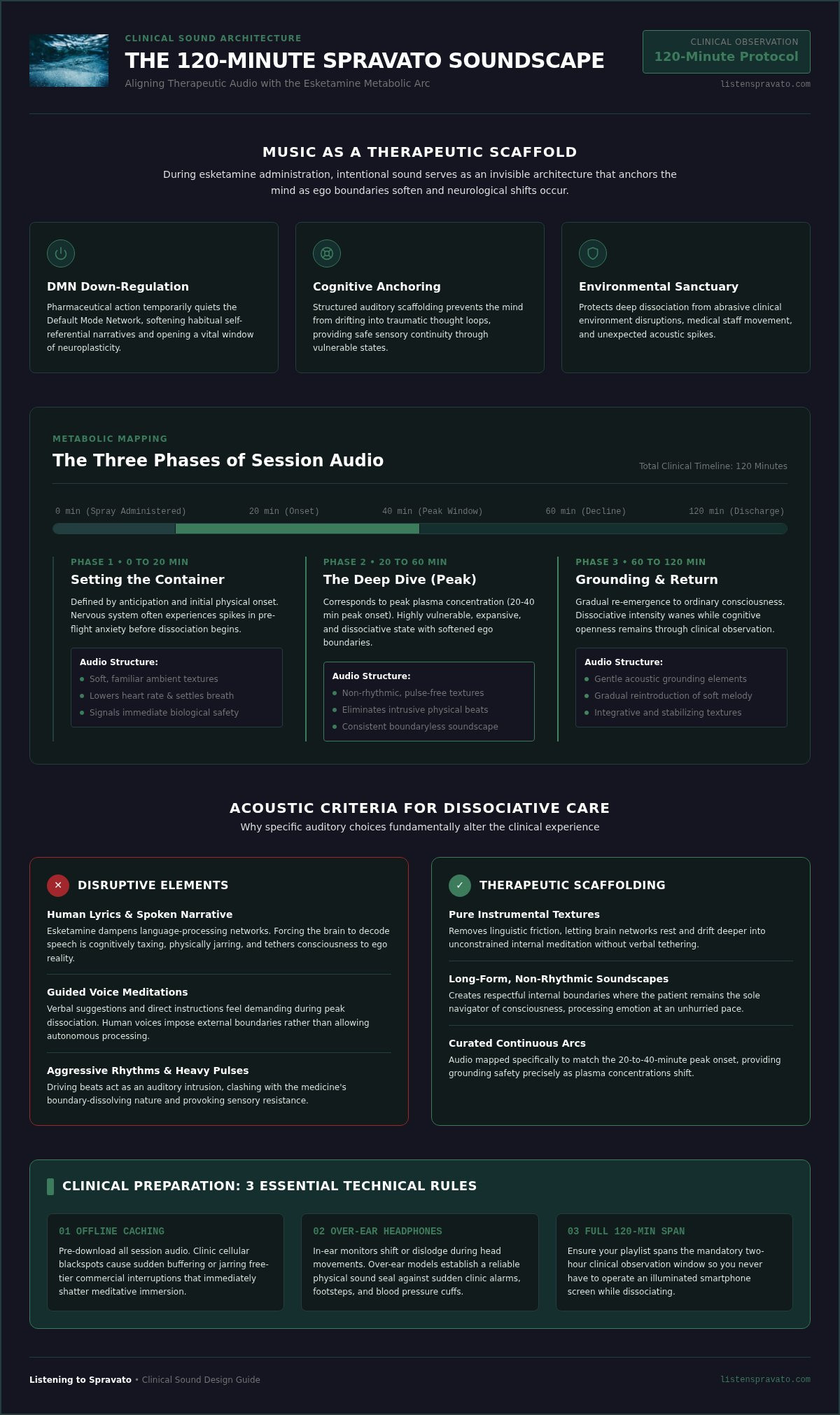
Music is not a luxury or a distraction during esketamine therapy; it's a fundamental component of the clinical environment. We view sound as a therapeutic scaffold. It provides a steady, invisible architecture that holds the patient as their usual sense of self begins to soften. When a provider administers esketamine nasal spray, the brain initiates a rapid neurological shift, including the temporary down-regulation of the Default Mode Network. This pharmaceutical action creates a window of profound neuroplasticity where the mind is highly sensitive to external stimuli.
Intentional auditory stimulation helps direct this sensitivity toward healing rather than anxiety. Many patients begin their journey by searching for free spravato playlists, yet the value of these resources lies in their curation. High-quality audio doesn't require a high price tag, but it does require a deep understanding of how sound interacts with a dissociative state. A well-constructed playlist acts as a cognitive anchor, preventing the mind from drifting into traumatic thought loops and instead facilitating a sense of safe, expansive exploration.
Why Lyrics Can Disrupt Your Session
The brain's attempt to decode language is a high-level cognitive task that requires significant energy. During the onset of treatment, esketamine temporarily dampens the activity of the brain's language-processing networks, making the effort of decoding speech feel cognitively taxing and physically jarring. When you hear lyrics, your mind instinctively tries to follow the narrative or analyze the meaning of the words. This process tethers you to your ego and the external reality you're attempting to transcend. By choosing instrumental tracks, you remove this cognitive friction, allowing your brain to rest and move deeper into the meditative experience without the distraction of human speech.
Music vs. Guided Meditations
While guided meditations are helpful in daily life, they often become intrusive during the peak phase of a Spravato session. The presence of a human voice, giving instructions or suggestions, can feel demanding when the mind is in a state of deep dissociation. Pure instrumental sound offers a more respectful boundary. It allows for an internal, unguided journey where you're the primary navigator of your own consciousness. Effective free spravato playlists prioritize these long-form, non-rhythmic textures to ensure you feel supported by the music without being directed by a voice. This balance of sound and silence creates a sanctuary where you can process emotions at your own pace, feeling both grounded and free.
The Three Phases of a Spravato Playlist
A Spravato session follows a predictable metabolic arc, and your music must mirror this journey to be effective. Many free spravato playlists fail because they treat the mandatory 120-minute observation period as a monolithic block of time. In reality, the brain moves through distinct phases of therapeutic music playlists that correspond to the medicine's plasma concentration. By aligning your audio with these shifts, you transform the music from a background element into a functional partner in your healing.
Phase 1: Setting the Container
The first 20 minutes of your session are defined by anticipation and the physical onset of the spray. During this window, your nervous system often experiences a spike in "pre-flight" anxiety. It's essential to use music for spravato treatment that signals immediate safety to the body. Soft, familiar ambient textures work best here. These sounds help lower your heart rate and settle your breathing, creating a warm, protective container before the more profound dissociative effects begin to take hold.
Phase 2: The Deep Dive
Between 20 and 60 minutes post-administration, the perceptual effects of esketamine typically reach their peak. This is the most vulnerable and expansive part of the experience. Music for this phase should lack a steady pulse or predictable melody, as strong rhythms can feel like a physical intrusion when your ego boundaries are softening. During this phase, the music serves as an auditory anchor, providing a consistent sensory thread that prevents the mind from feeling adrift while the usual structures of reality fade. This boundaryless soundscape allows you to immerse yourself fully in the internal experience without the fear of being jarred by sudden musical changes.
Phase 3: Coming Back
As you enter the second hour, the intensity of the dissociation begins to wane, and you start the process of integration. This is the time to navigate the Spravato experience by gradually re-introducing organic sounds. Acoustic instruments like the cello or a sparse piano provide a gentle bridge back to the physical world. These warmer textures support emotional processing and help you ground your insights into your body before you leave the clinic. Timing your playlist is simple: press play immediately after the final spray is administered to ensure the music shifts exactly when your brain does. For a more tailored experience, you can explore our curated audio collections designed specifically for these metabolic transitions.
Where to Find the Best Free Spravato Playlists
Searching for free spravato playlists on streaming platforms often yields thousands of results, but quantity does not equal clinical utility. Many user-generated lists are simply collections of "chill" songs that lack the intentional sequencing required for an esketamine session. To find audio that truly supports your healing, you must look for curation that understands the intersection of neuroscience and sound. High-quality playlists typically center on three primary genres: Ambient, Modern Classical, and Minimalist. These styles provide the necessary depth and resonance without the rhythmic or melodic spikes that can jar the senses during deep dissociation.
The Listening to Spravato® Free Collection
The core of our mission is to provide patients with a reliable, scientifically grounded starting point. Justin Page, a conservatory-trained musician and Spravato patient himself, meticulously curated five distinct collections to serve as a definitive resource. These selections aren't just background music; they're designed to facilitate the specific psychological shifts that occur during treatment. Each track is chosen for its acoustic architecture, ensuring it provides a steady foundation from the first spray to the final grounding. You can access these free Spravato playlists on Spotify, YouTube Music, and Apple Music to ensure your next session is held within a professional soundscape.
Navigating Spotify and YouTube for Spravato
If you decide to explore other public options, you must be a meticulous editor of your own experience. We recommend vetting any new playlist at least 24 hours before your appointment. When searching, avoid terms like "meditation with lyrics" or "guided relaxation," as the presence of a human voice can be highly disruptive during the peak phase. Instead, look for long-form drone or sacred minimalism. There are three critical technical checks you should perform before committing to a list:
- Verify total length: Ensure the playlist covers the full 120-minute observation period required by the REMS program. A playlist that ends too early can leave you feeling exposed in a bright, clinical room before you're ready.
- Check for "Hidden" lyrics: Listen to the middle of the playlist to ensure no vocal samples or narrative elements appear during what would be your peak dissociative window.
- Identify ad risks: On free streaming tiers, ads trigger every 10 to 15 minutes. These commercial interruptions are not just annoying; they can cause acute sensory distress or panic during a dissociative state.
A reliable playlist acts as a silent, supportive partner. By choosing vetted resources, you ensure that your focus remains on your internal journey rather than technical interruptions or jarring musical shifts.
Technical Setup: Ensuring a Seamless Audio Experience
Even the most meticulously curated free spravato playlists lose their efficacy if the technical delivery is interrupted by a poor connection or a sudden notification. Technical intentionality is a form of self-care. It ensures that your focus remains entirely on your internal journey rather than on troubleshooting a device while in a dissociative state. By preparing your hardware and software before you enter the clinic, you create a reliable container for your experience.
Hardware and Comfort
Over-ear headphones with Active Noise Cancellation (ANC) are the clinical standard for a reason. Medical suites are rarely silent; you'll likely hear the rhythmic hum of vitals monitors, hallway chatter, or the distant click of doors. High-quality ANC creates a necessary vacuum, allowing the music to become your entire environment. While earbuds are portable, over-ear models provide a physical seal that signals to your brain that it's time to turn inward. You should also ensure your devices are fully charged before you arrive. A low-battery alert mid-peak is a startling and distressing intrusion that's easily avoided. Coupling your audio with a contoured eye mask further deepens this immersion, removing visual stimuli so the sound can take center stage.
The 'No-Distraction' Protocol
Your smartphone is a gateway to the external world, which is exactly what you want to avoid during treatment. Setting your device to "Do Not Disturb" is non-negotiable. Even a vibrating notification can tether you back to your ego at a moment when you're seeking expansion. Most medical suites are built with thick, lead-lined walls that often interfere with clinic Wi-Fi, leading to frustrating buffering or track skips. Always download your free spravato playlists locally to your device to ensure the music never falters. Perform a brief audio check to confirm your volume levels and download status before the first spray is administered.
Finding the therapeutic "sweet spot" for volume is a personal process. It should be loud enough to envelop you, yet soft enough to avoid physical discomfort or ear fatigue. Remember that Spravato is typically administered in three doses, five minutes apart. You may choose to pause your music during these brief interactions with your provider or let it play at a lower volume to maintain your meditative state. For a complete guide on preparing your physical and digital environment, explore our Spravato session checklists.
Deepening Your Practice with the Listening to Spravato Guide
Accessing free spravato playlists is a vital first step toward a more comfortable treatment, but it's only the beginning of a truly intentional healing practice. A playlist provides the sound, but a protocol provides the purpose. While the music acts as a scaffold, understanding the methodology behind the selection allows you to engage more deeply with the therapeutic process. Moving from passive listening to an active, informed practice can significantly shift how you perceive and integrate the insights gained during your session.
Beyond the Playlist: The Full Protocol
The Listening to Spravato book, available in both print and digital editions, offers the deep context that a simple tracklist cannot provide. It serves as a comprehensive manual for personalized session planning, offering genre-by-genre guides that help you tailor the audio experience to your unique emotional landscape. Justin Page shares insights from both a conservatory-trained musician’s perspective and a patient’s lived journey, bridging the gap between clinical neuroscience and the artistic power of sound. For clinicians, these resources offer a reliable way to standardize patient care, ensuring that everyone in their suite has access to the same high level of therapeutic scaffolding. This structure helps demystify the experience, replacing uncertainty with a sense of quiet confidence.
The Immersive Audiobook Experience
For patients who prefer a more guided approach, the Listening to Spravato audiobook offers a uniquely immersive experience. Narrated by Justin Page himself, the audiobook acts as a "Learned Guide," connecting the nuances of the music directly to the physiological shifts of the medicine. It’s an ideal companion for those who want a structured narrative to follow during their preparation or the integration phase of the second hour. You can find this immersive guide on major platforms including Apple Books, Spotify, and Kobo. By integrating these deeper resources with your free spravato playlists, you move from being a passive recipient of treatment to an active participant in your own neurological recovery. This methodical approach ensures that every session is not just a medical appointment, but a refined and elegant step toward lasting health.
Step into Your Next Session with Intention
Music is the invisible architecture of your healing. By understanding how sound interacts with the neurobiology of esketamine, you move from being a passive observer to an active participant in your recovery. You've learned how to align your audio with the medicine's metabolic arc and how to protect your session from the jarring intrusions of technical errors or lyrics. Utilizing high-quality free spravato playlists is a vital foundation, but it's only the beginning of a truly refined therapeutic practice.
As featured in AP News and EIN Presswire, our methodology is authored by a conservatory-trained musician and trusted by leading esketamine clinics nationwide. We invite you to download the free Spravato playlists and get the book to fully integrate these clinical insights into your journey. You deserve a treatment environment that feels safe, structured, and deeply supportive. With the right soundscape as your companion, you can navigate your next session with a sense of quiet confidence and purpose.
Frequently Asked Questions
Do I really need a special playlist for Spravato, or is my usual music okay?
A specialized playlist is highly recommended because standard music often contains sudden shifts in tempo or volume that can be jarring during dissociation. Spravato creates a state of heightened sensory sensitivity where your usual favorites might feel overwhelming or tether you too closely to your ego. Curated free spravato playlists provide a therapeutic scaffold designed to mirror the medicine's metabolic arc, ensuring your environment remains stable and supportive.
Why are lyrics considered bad for esketamine or ketamine treatment?
Lyrics activate the brain's language-processing centers, which are areas the treatment naturally seeks to quiet. When you hear words, your mind instinctively attempts to decode meaning and narrative; this cognitive effort can pull you out of a deep meditative state. Pure instrumental sound allows the mind to wander freely without the distraction of human speech. It preserves the internal nature of the journey and prevents external storytelling from directing your experience.
How long should my Spravato playlist be?
Your playlist should be at least 120 minutes long to cover the entire mandatory observation period required by the FDA REMS program. Many patients prefer a selection lasting 130 minutes to ensure there is no abrupt silence if the clinical discharge process takes a few extra moments. This duration accounts for the initial administration, the 40 minute peak concentration, and the final hour of grounding and integration before you leave the clinic.
Is it better to use Spotify or YouTube for my session music?
Both platforms are viable, but your choice depends on your subscription level and the clinic's connectivity. Spotify is often preferred for its robust offline mode and crossfade settings, which eliminate gaps between tracks. YouTube offers excellent long-form ambient videos, but the risk of mid-roll ads on free tiers is significantly higher. Regardless of the platform, always download your free spravato playlists locally to avoid buffering caused by spotty medical suite Wi-Fi.
Can I listen to white noise or nature sounds instead of music?
You can, but nature sounds often lack the harmonic structure needed to provide a consistent scaffold for the dissociative experience. While white noise can mask clinic sounds, it doesn't offer the emotional resonance or movement that instrumental music provides. Many patients find that sacred minimalism or drone music offers a better balance; it provides a consistent sonic texture while still allowing for a sense of meaningful internal journeying.
What should I do if an ad plays during my Spravato session?
If an ad plays, try to remain as still and calm as possible. Don't fumble with your device, as physical agitation can disrupt your focus. The best strategy is prevention through an ad-free subscription or downloading files for offline playback. If an interruption occurs, focus on your breath and wait for the music to return. Treat the interruption as a passing cloud rather than a reason for distress or panic.
How do I time the music with the three doses of the nasal spray?
Press play immediately after your final spray is administered. This ensures the music's onset phase aligns with the 5 to 10 minutes it takes for the medicine to begin its neurological shift. If you prefer music during the administration itself, start the playlist at the first dose. Be prepared for brief pauses if your provider needs to speak with you during the five minute intervals between the individual sprays.
Are there free Spravato playlists specifically for anxiety vs. depression?
Most curated collections focus on the intensity of the experience rather than a specific diagnosis. However, lists for anxiety often utilize slower tempos and softer ambient drones to lower the heart rate. Lists for depression might incorporate more organic textures, like cello or piano, during the integration phase to support emotional processing. The primary goal is always to create a sense of safety and dignity, regardless of the specific symptoms being treated.


