

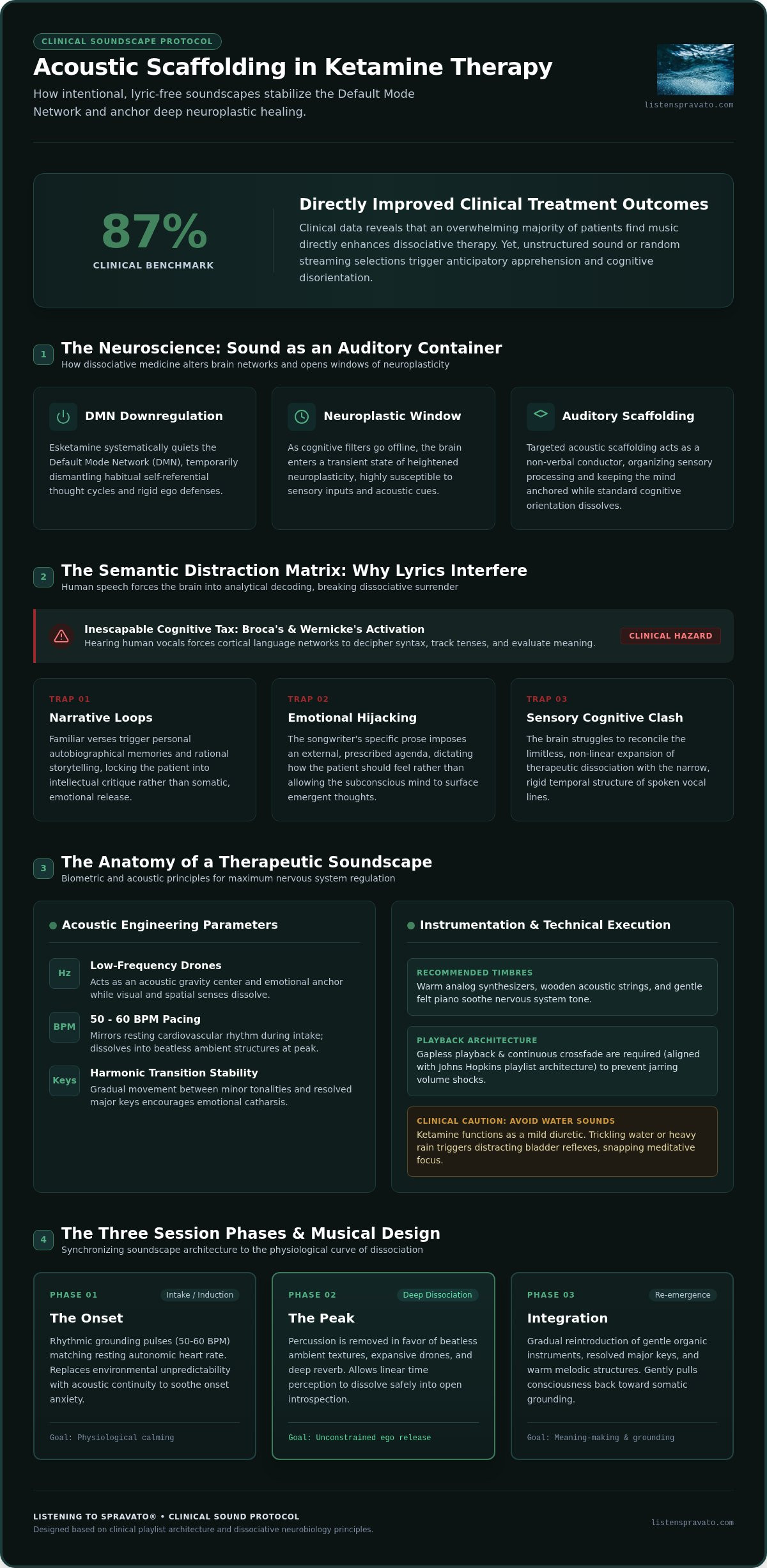
Clinical data reveals that 87% of patients find music directly improves their treatment outcomes, yet preparing for an altered state often triggers deep apprehension. When you face the unfamiliar territory of dissociation, selecting the right instrumental music for ketamine therapy provides vital therapeutic scaffolding, keeping you anchored while the medicine opens new neural pathways. If you feel overwhelmed by infinite streaming options or worry that an unexpected lyric might derail your mindset, your instincts are spot on. Words stimulate the brain's analytical language networks, abruptly interrupting introspective healing when you need quiet surrender most.
In this guide, you'll discover why lyric-free sound forms the bedrock of a safe, restorative session, and how intentional acoustic textures support each phase of your experience. We'll explore safe, clinic-tested genres and unpack the neuroscience behind sound selection, giving you the practical clarity needed to replace session anxiety with calm, grounded reassurance.
Key Takeaways
- Learn how selecting intentional instrumental music for ketamine therapy silences analytical language networks, creating the mental space needed for emotional surrender.
- Discover the stabilizing role of low-frequency drones and gapless transitions, which safeguard your mindset against jarring shifts during deep dissociation.
- Explore safe, clinic-tested genres from ambient soundscapes to neoclassical compositions that nurture emotional depth without intrusive words.
- Master the three distinct acoustic phases designed to match the onset, peak, and integration stages of your therapeutic session.
- Uncover how structured resources like Listening to Spravato® and phase-specific playlists provide a reliable framework to lower pre-session anxiety.
Why Instrumental Music is Essential for Ketamine Therapy
Entering an altered state of consciousness requires deliberate surrender. When dissociation begins, the mind instinctively seeks reference points to orient itself within an unfamiliar internal landscape. Curated instrumental music for ketamine therapy provides an unwavering foundation, systematically lowering anticipatory set and setting anxiety by replacing environmental unpredictability with acoustic continuity. Without the intrusion of spoken language, pure sound provides room for profound emotional resonance, allowing you to observe internal shifts with calm curiosity rather than fear.
The Neuroscience of Sound and Esketamine
Dissociative treatments interrupt habitual brain patterns by downregulating the default mode network (DMN), the interconnected neural web responsible for self-referential thought and rigid ego defenses. As this network quiets, a transient window of heightened neuroplasticity opens. Sound acts as a non-verbal conductor during this phase, subtly organizing sensory input and emotional processing while standard cognitive filters remain offline.
Modern clinical research and standardized psychedelic and dissociative therapy protocols consistently rely on targeted acoustic environments to prevent disorientation during deep introspection. Scaffolding, in this context, serves as the steady auditory container that holds the mind safe while the medicine does its work.
The Problem with Lyrics: Semantic Distraction
Human speech carries an inescapable cognitive tax. Hearing a human voice, even in a beloved, gentle ballad, immediately recruits Broca's and Wernicke's areas. These cortical language centers force the brain to decipher syntax, track tenses, and evaluate meaning, snapping you straight out of non-ordinary awareness.
Lyrics complicate the session in several distinct ways:
- Narrative loops: Familiar verses trigger personal memories and autobiographical storytelling, locking you into intellectual analysis rather than somatic processing.
- Emotional hijacking: The songwriter's specific narrative imposes an external agenda, dictating how you should feel rather than allowing your unconscious mind to surface what needs attention.
- Sensory cognitive clash: The brain struggles to reconcile the expansive nature of dissociation with the narrow, linear structure of spoken phrases.
Choosing dedicated instrumental music for ketamine therapy preserves an open canvas. Unencumbered by someone else's story, open harmonic textures invite you to project your own emergent meaning, safely guiding your attention inward throughout the treatment.
The Anatomy of a Therapeutic Soundscape
Building effective instrumental music for ketamine therapy requires deliberate acoustic engineering. Sound acts as an emotional floor when your visual and spatial senses dissolve. Low-frequency drones provide a persistent center of gravity, keeping you tethered while higher frequencies drift and expand. Timbre matters just as much. Warm analog synthesizers, wooden strings, and gentle felt piano soothe the nervous system, whereas harsh digital transients can feel abrasive. Harmonic stability keeps the session safe; gradual shifts between gentle minor tonalities and resolved major keys encourage catharsis without tipping into distress.
Rhythm and Pulse: Finding the Heartbeat
Pacing directly dictates physiological calm. During initial intake, rhythmic pulses between 50 and 60 beats per minute encourage autonomic relaxation, matching a resting cardiovascular rhythm. As you enter peak dissociation, however, explicit percussion often feels intrusive. Beatless ambient structures allow the sensation of time to dissolve naturally.
Technical execution is just as critical as musical composition. An abrupt silence between tracks or a jarring volume spike shocks an open nervous system. Enabling continuous crossfade and gapless playback preserves an unbroken continuum, reflecting the intentional design principles documented in the Johns Hopkins therapeutic playlist architecture.
Atmosphere and Depth
Reverb and delay widen the acoustic horizon, giving introspective insights space to unfold. Tone color determines whether that space feels inviting or alienating. Sterile digital presets often feel cold and isolating, whereas warm, tape-saturated organic textures envelop the listener with physical comfort.
Organic elements require careful discretion. Gentle wind or forest rustling can ground the body, but experienced clinicians specifically caution against tracks with trickling water or rainfall. Ketamine acts as a mild diuretic, and water sounds frequently trigger distracting bladder sensations that pull you out of deep meditation. Selecting dedicated instrumental music for ketamine therapy ensures every frequency protects your focus. For listeners seeking a seamless, tested acoustic companion, exploring curated Spravato® playlists offers a dependable way to experience these production principles firsthand.
Essential Genres for Your Ketamine Playlist Roundup
Not all lyric-free tracks provide equal psychological safety. Mainstream streaming platforms often lump all non-vocal audio into generic relaxation bins, yet a sudden orchestral surge or dissonant chord can provoke acute distress during an altered state. Curating instrumental music for ketamine therapy requires an ear for acoustic temperament. From a musician's vantage point, the goal is finding harmonic stability, spacious arrangements, and textures that hold emotional weight without triggering defensive reactions.
Ambient and Drone: The Foundation
Pioneered by innovators like Brian Eno, ambient music thrives by being as ignorable as it is interesting. In a Spravato® session, sustained drone textures serve as the ultimate safe harbor. These pieces feature seamless acoustic blankets that lack distinct beginnings, middles, or endings, effectively suspending your perception of linear time. You never find yourself bracing for an abrupt dynamic drop or sudden tempo change. To explore sequences built specifically around these uninterrupted soundbeds, review our curated selection in Free Spravato Playlists: A Curated Guide to Music-Assisted Healing (2026).
Neo-Classical: The Emotional Guide
Where pure drone provides spatial containment, modern neoclassical composition introduces gentle, wordless storytelling. Acoustic piano and bowed strings lend warmth, beauty, and emotional dignity to introspective reflection. Works by composers like Max Richter, Jóhann Jóhannsson, and Nils Frahm establish a grounded narrative without verbal interference.
Discrimination remains essential when exploring classical territory. Standard orchestral masterworks often incorporate sudden brass flourishes, dramatic dissonance, or turbulent crescendos. While Stravinsky or Mahler may be brilliant in a concert hall, their volatile dynamic shifts can feel terrifying during deep dissociation. Supportive neoclassical pieces favor slow, circular harmonic movements that resolve softly, preserving your sense of safety.
Minimalism and World Ambient
Two additional styles round out an effective auditory toolkit:
- Minimalism: Repetitive, cyclical phrases from solo piano, harp, or gentle marimba establish a steady hypnotic rhythm, quietening mental chatter into a calm trance state.
- World ambient: Atmospheric soundscapes incorporating overtone flutes, handpans, or tanpura drones offer expansive resonance, gently inviting the mind into peaceful, uncharted internal territory.
Balancing these genres ensures that your instrumental music for ketamine therapy supports emotional release while guarding against sensory overload.
Curating the Journey: Music for Every Phase
Ketamine treatment is not a static, uniform state. It moves along a clear pharmacokinetic curve that demands a matching auditory progression. Aligning your instrumental music for ketamine therapy with these distinct shifts prevents cognitive resistance, letting the sonic architecture support your nervous system at every milestone. When playlists mirror each chapter of the session, the auditory field transitions smoothly from an onboarding sanctuary into deep non-ordinary space, then gently guides you back to baseline.
Managing the Onset with Gentle Sound
The first twenty minutes establish your psychological baseline. S-ketamine nasal administration and racemic infusions both present an abrupt shift as everyday sensory awareness begins to soften. Research shows that slow-tempo, ambient soundscapes ease autonomic nervous system arousal, actively mitigating the transient pulse and blood pressure spikes common during initial NMDA receptor uptake. Warming synthesizer pads, soft solo piano, and spacious textures create an inviting environment that reassures the mind during the transition.
Timing your playback properly makes a measurable difference. Start your music five to ten minutes before medication administration. Putting on your headphones and eye shades early eliminates clinical distractions like fluorescent lights or door clicks, ensuring you enter the therapeutic space fully settled. For a deeper look at tailoring these soundbeds across various medical routes, explore The Best Music for Ketamine Infusion: A Guide to Therapeutic Soundscapes.
Phase-Specific Sequencing
Structuring your listening arc around three core phases keeps the mind held throughout the full clinical timeline:
- Phase 1: Onset (0 to 20 minutes): Gentle, non-rhythmic ambient warmth that invites physical surrender and eases anticipatory anxiety.
- Phase 2: The Peak (20 to 60 minutes): Expansive, beatless drone and vast neoclassical soundscapes that support ego dissolution without imposing emotional direction.
- Phase 3: Integration (60 to 120 minutes): Grounding acoustic arrangements, light jazz chords, and subtle rhythms that help you land safely back into ordinary awareness.
Integration: Landing Safely
The return to waking reality requires careful nurturing. As dissociation recedes during the mandatory two-hour observation window, the mind remains exceptionally impressionable. Organic instrumentation like fingerpicked acoustic guitar or felted piano reintroduces tangible, physical textures, grounding you back in your body before you interact with clinical staff. These closing integration tracks often serve as an emotional bridge, helping you articulate non-verbal insights when discussing your experience with your provider.
Always keep an "emergency track" ready in your queue. If an introspective loop feels overwhelmingly heavy, switching to a familiar, reassuring acoustic piece acts as a sensory lifeline, pulling your focus back to safety. To access fully mapped, phase-matched soundbeds engineered specifically for these transitions, explore curated Spravato® playlists designed to support every step of your clinical session.
Deepening the Experience with "Listening to Spravato"
Approaching an altered state without a clear framework often leaves patients feeling untethered. While assembling random tracks offers a starting point, building an intentional acoustic container demands deeper insight. In Listening to Spravato®: Sound, Silence, and the Medicine of Music, conservatory-trained musician and patient Justin Page bridges formal acoustic theory with firsthand clinical experience. The book functions as a genre-by-genre roadmap, helping you choose the right instrumental music for ketamine therapy without second-guessing track choices. Reading the physical print edition also lets you prepare away from screens and digital notifications, establishing mental stillness before your appointment begins.
The Audiobook Advantage
Audio provides an exceptionally intimate, grounding presence during session preparation. In the Listening to Spravato® Audiobook, Page narrates the core acoustic protocols directly. His calm cadence helps settle an anxious nervous system well before you settle into the clinic chair. Hearing an experienced musician describe the subtle interplay of harmonic shifts and drone frequencies demystifies the entire experience, giving you quiet confidence as your appointment approaches. To bring this reassuring companion into your routine, Purchase the Listening to Spravato Audiobook for your next session.
Clinical Scaffolding for Home or Clinic
A structured auditory protocol transforms how you experience treatment. Endorsed by healthcare providers working with treatment-resistant depression, these listening frameworks give patients and medical staff a common reference point for sensory care. During the mandatory two-hour observation period, clinical rooms can easily feel sterile, cold, or intimidating. Integrating vetted, phase-matched soundscapes elevates that time into a dignified, intentional ritual centered entirely on your internal recovery.
Predictable acoustic textures protect your attention, preventing sudden alarms or hallway chatter from disrupting delicate mental states. Ultimately, selecting dedicated instrumental music for ketamine therapy ensures you remain safely anchored from the moment the medicine begins until you return to baseline. Sound is not just what you hear during treatment; it is the scaffolding through which you heal.
Stepping Into Your Session with Quiet Confidence
Entering an altered state doesn't have to feel like stepping off a cliff into the unknown. When you replace arbitrary playlists with intentional instrumental music for ketamine therapy, sound becomes your most dependable companion. Lyric-free soundscapes safeguard your cognitive space from distracting narrative loops, while phase-matched acoustic transitions hold your nervous system steady from initial onset through quiet integration.
You don't need to navigate this sensory terrain by guesswork. Authored by conservatory-trained musician and patient Justin Page, the Listening to Spravato® framework provides clinically endorsed, phase-specific protocols designed to dismantle pre-treatment anxiety. Available in Print, Digital, and Audiobook editions, these tools help you turn a sterile medical setting into an intentional container for lasting change. Order the Listening to Spravato Guide & Audiobook today, and step into your next appointment with profound clarity, purpose, and calm reassurance.
Frequently Asked Questions
Why is instrumental music better than my favorite songs with lyrics?
Instrumental music prevents cognitive disruption by leaving language processing networks disengaged. Hearing familiar lyrics forces your brain to analyze vocabulary and autobiographical memories, pulling you out of non-ordinary awareness. Choosing dedicated instrumental music for ketamine therapy offers an open, wordless canvas, allowing personal emotions to surface naturally without being directed or hijacked by a songwriter's specific story.
Can I listen to classical music during my ketamine therapy?
Yes, but you must select pieces with extreme care. While gentle neoclassical works featuring solo piano or muted strings provide soothing emotional structure, standard classical symphonies often feature sudden brass crescendos, intense percussion, or sharp dynamic shifts. These abrupt acoustic spikes can feel startling or frightening during dissociation. Stick to calm, modern composers who emphasize steady, circular harmonies rather than dramatic orchestral tension.
What happens if the music stops during my Spravato session?
Sudden silence can feel disorienting and jarring when your sensory processing is heightened. If your audio cuts out, clinic noises like distant footsteps, air conditioning hums, or hallway chatter can abruptly break your introspective flow and spark mild panic. Always download your audio files offline, turn off device notifications, and ensure your streaming app has gapless playback enabled to prevent unexpected dropouts.
Should I use noise-canceling headphones for ketamine infusions?
Yes, comfortable over-ear noise-canceling headphones are strongly recommended. Clinical environments contain unpredictable acoustic interruptions, from medical monitors to opening doors. Active noise cancellation seals your sensory container, blocking outside distractions so you stay safely immersed in your soundscape. Make sure the earcups fit loosely enough to avoid physical pressure on your temples, keeping your body physically relaxed throughout the entire infusion.
How loud should the music be during the peak phase?
Set your volume at a moderate, comfortable level before your session starts, typically between 40% and 60%. Dissociative states significantly increase auditory sensitivity, making loud volumes feel invasive or overwhelming once the peak begins. You want the soundscape to envelop your awareness like a soft acoustic blanket without creating physical ear fatigue or triggering sensory overload when acoustic layers build.
Is it okay to change the playlist in the middle of a session?
It is best to avoid touching your device during a session. Interacting with bright screens or complicated menus forces your eyes open, breaks your meditative state, and abruptly interrupts therapeutic processing. If a transition feels necessary, ask your clinic monitor for gentle assistance, or rely on a pre-sequenced playlist designed to navigate the natural onset, peak, and integration phases automatically.
Can nature sounds (like rain or ocean waves) be used instead of music?
Pure nature tracks can work, but they present hidden sensory hazards. Gentle wind or rustling leaves offer grounding textures, but recordings heavy in rainfall, trickling streams, or running water are widely discouraged. Ketamine acts as a mild diuretic. Water sounds frequently stimulate acute bladder awareness, breaking your introspective concentration and forcing an uncomfortable, premature trip to the clinic restroom.
What is the "Emergency Track" and why do I need one?
An emergency track is a deeply familiar, calming piece of instrumental music for ketamine therapy queued up in case a session feels overly intense. If you experience distressing thoughts or emotional turbulence, playing this grounding anchor acts as a sensory beacon. Its recognizable melody immediately reminds your nervous system that you are safe, resting comfortably in a clinic, and fully in control.


