

The standard ambient track you rely on for daily relaxation can easily derail a clinical treatment. When the default mode network downregulates during peak dissociation, an unexpected beat drop, a sudden volume spike, or recognizable lyrics can instantly jar the nervous system. Finding the right ketamine infusion playlist spotify provides is not merely a matter of saving soothing background music; it's about establishing a dependable, nonverbal scaffold. Yet searching through thousands of unvetted community playlists often brings confusion, sensory overwhelm, and valid fears of disruptive surprises.
You shouldn't have to worry about jarring transitions or sudden technical faults while engaged in deep therapeutic work. You can take complete control of your session soundscape with deliberate preparation. This guide walks you through error-proof Spotify playback configurations that eliminate track gaps, proven auditing methods to screen out destabilizing music, and structured soundscapes designed to match each biological phase of your infusion. Here is how to create a supportive, distraction-free environment for your healing.
Key Takeaways
- Discover how a properly vetted ketamine infusion playlist spotify setup acts as an acoustic anchor, filtering out abrupt volume shifts and vocal triggers that can disrupt neuroplastic states.
- Learn the precise mobile playback adjustments, from crossfade buffers to offline caching, that protect your clinical session from track gaps and connection dropouts.
- Understand why generic ambient study playlists fail therapeutically, and how to audit public compilations for emotional safety before stepping into the clinic.
- Master the three-phase musical arc designed to mirror the pharmacokinetics of your infusion, providing continuous stability through onset, peak dissociation, and gentle return.
- Explore how pre-session auditory preparation replaces technical anxiety with confidence, allowing you to focus entirely on your therapeutic healing.
The Essential Criteria for a Ketamine Infusion Playlist on Spotify
Music serves as an external nervous system during an altered state of consciousness. In clinical settings, auditory input functions as a reliable container, anchoring perception when ordinary spatial awareness dissolves. Ketamine alters sensory gating, meaning the brain loses its ordinary ability to filter out background noise or harmonize unexpected acoustic shifts. Saving an unvetted ketamine infusion playlist spotify search serves up creates substantial psychological risk. A sudden percussion snap or volume spike can instantly shatter feelings of safety, transforming an introspective journey into acute distress.
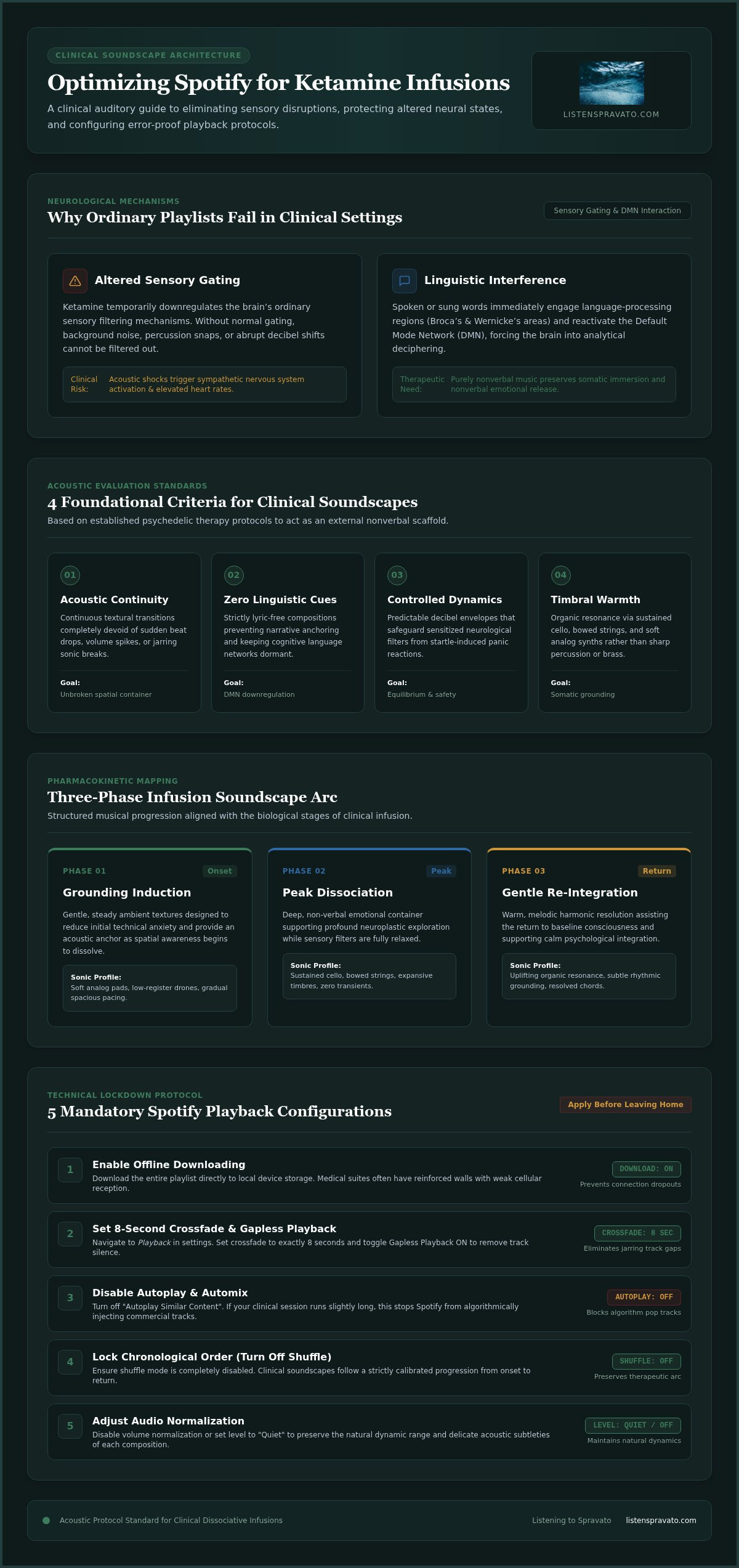
A dependable therapeutic soundscape requires rigorous consistency. Drawing from established psychedelic therapy protocols, auditory tracks act as non-verbal guides that sustain emotional equilibrium rather than mere background entertainment. Patients should evaluate four foundational criteria before selecting any streaming soundtrack:
- Acoustic continuity: Seamless textural transitions devoid of sudden drops or jarring breaks.
- Absence of linguistic cues: Purely nonverbal composition to keep cognitive centers at rest.
- Controlled dynamics: Predictable decibel levels that protect lowered sensory filters.
- Timbral warmth: Organic, resonant frequencies that support somatic grounding.
Why Lyric-Free Soundscapes Are Non-Negotiable
Human speech activates the default mode network and engages language processing regions like Broca's and Wernicke's areas. When recognizable words enter an infusion session, the brain instinctively shifts into analytical deciphering. Familiar lyrics tether your awareness to external concepts, personal memories, or specific narratives, which actively halts nonverbal emotional release. Explore our comprehensive guide on why lyric-free music is crucial for preserving uninterrupted therapeutic depth.
Managing Dynamic Range and Instrumentation
A sudden brass crescendo or sharp percussive transient can provoke an involuntary startle response. During dissociative states, these acoustic shocks trigger sympathetic nervous system activation, elevating heart rates and introducing panic. Prioritize organic instrumentation like sustained cello, bowed strings, and soft analog synthesizer pads. These warm textures produce continuous acoustic resonance, cradling awareness while preventing the sensory overwhelm caused by erratic volume fluctuations.
How to Configure Spotify Settings for Clinical Infusions
Default streaming setups are designed for casual listening, not medical treatments. Standard app behaviors like automated recommendations, sudden volume normalizations, and network buffering can instantly disrupt an internal journey. Many clinical suites are located in reinforced medical buildings where cellular reception fluctuates. If your connection drops during treatment, silence abruptly breaks your immersion. Configuring your ketamine infusion playlist spotify setup in advance ensures technical friction never compromises your therapeutic space.
Step-by-Step Spotify App Optimization
To ensure music mirrors the structured progression popularized by the Johns Hopkins playlist framework, you must lock down the playback engine. Open Spotify's settings menu on your mobile device and apply these critical adjustments before leaving home:
- Enable Offline Downloading: Download the entire playlist directly to your local device storage. Never stream over clinic Wi-Fi or mobile data.
- Configure Crossfade: Navigate to Playback and set crossfade to eight seconds while toggling Gapless Playback on. This eliminates the silence between movements.
- Disable Autoplay and Automix: Turn off Autoplay Similar Content. If your session runs long, you don't want Spotify's recommendation algorithm suddenly injecting high-energy commercial pop.
- Turn Off Shuffle: Ensure chronological playback is locked. Infusion soundscapes require an intentional progression from onset to integration.
- Adjust Audio Normalization: Disable normalization or set it to "Quiet" to preserve organic dynamics, ensuring delicate acoustic passages stay natural without sudden decibel shifts.
Device Lockdown and Headphone Preparation
App settings solve only half the equation. Your phone's operating system must also be silenced to protect your mental container. Before reclining in the clinical chair, switch your device into Airplane Mode and turn on Do Not Disturb. This double-layer defense blocks incoming calls, text chimes, and push notifications from bleeding into your headphones.
Always verify that your downloaded audio plays smoothly while offline before entering your appointment. Charge over-ear noise-cancelling headphones to 100 percent, and keep a physical audio cable in your bag in case Bluetooth fails. If you prefer avoiding manual configuration altogether, explore the pre-built options at listenspravato.com, where tracks are already engineered for therapeutic stability.
Evaluating Community Playlists vs. Clinically Curated Soundtracks
Public streaming compilations are rarely designed for clinical medicine. Most community selections are built for background concentration, late-night reading, or casual yoga sessions. While a crowd-sourced mix may look appealing because of thousands of followers, popularity algorithms cannot assess somatic safety. What feels soothing during light study can feel intensely chaotic when your sense of self begins to uncouple. Choosing an unverified ketamine infusion playlist spotify algorithm promotes can expose you to sudden shifts between dissonant electronic synthesis and orchestral movements, destabilizing your mental space.
Clinically curated soundscapes work differently. They deliberately match tempo, key modulation, and tonal density to the physiological phases of treatment. This intentional structuring matters on a biological level. A recent clinical trial on music during ketamine infusions demonstrated that structured auditory support significantly lowers cardiovascular reactivity and improves patient tolerability during sessions. Sound is not background decoration; it is functional scaffolding.
The Limitations of Generic Ambient and Drone Playlists
Static drone recordings seem safe on paper, but continuous, unchanging frequencies often backfire. Without subtle harmonic movement, an unvarying low drone can induce a sense of cognitive trapping, amplifying existential dread during deep peak states. Your mind needs forward emotional momentum. Exploring dedicated instrumental soundscape alternatives provides balanced melodic progression, offering a gentle handrail that moves you forward rather than leaving you stranded in heavy acoustic stasis.
Vetting Key Indicators in Track Selection
Auditing a candidate playlist requires examining the structure behind the titles. Protect your session by reviewing these technical markers before pressing save:
- Track Durations: Look for compositions that run longer than five minutes. Brief three-minute tracks produce frequent structural shifts that disrupt deeper processing.
- Hidden Vocal Elements: Check credits and listen in advance for uncredited vocalizations, spoken word samples, or distant whispering, which can trigger acute paranoia.
- Rhythmic Intrusions: Scan waveforms for sudden synthetic bass drops or sharp hi-hats that slice through soft ambient layers.
- Total Runtime Buffer: Confirm the collection extends at least twenty minutes past your expected clinic window to prevent jarring cutoffs if discharge checks take longer.
Mapping Your Playlist Arc to the Three Infusion Phases
An intravenous ketamine infusion follows a predictable pharmacokinetic curve. Over approximately forty-five minutes, active serum levels rise, peak, and clear. Structuring your ketamine infusion playlist spotify queue to mirror this biological progression eases psychological resistance, helping you surrender to the medicine rather than bracing against it. A clinically functional soundtrack divides into three intentional phases: descent, peak, and re-emergence.
Phase 1: Descent and Settling (Minutes 0–15)
The opening tracks set the emotional tone for your entire appointment. As the clinical line opens and physical sensations begin to soften, your mind naturally searches for stability. Auditory selections during this initial window should feature mid-tempo, grounding acoustic instruments, such as low-register cello or gentle, resonant piano. These warm textures encourage parasympathetic regulation and somatic grounding. Review our recommendations for free curated playlists that illustrate how to pace this crucial opening window.
Phase 2: The Dissociative Peak (Minutes 15–45)
During peak immersion, the brain's default mode network downregulates, uncoupling standard perceptions of time, space, and physical form. Acoustic arrangements must expand accordingly. Rigid rhythmic percussion should yield to suspended, continuous synthesizer washes, ambient drones, and wide orchestral textures. Harmonies during this stage must remain emotionally neutral or subtly elevating. Heavy, minor-key compositions can inadvertently steer the psyche toward unresolved grief, whereas open, unresolved chords allow safe internal exploration without demanding a specific emotional reaction.
Phase 3: Grounding and Re-Emergence (Minutes 45–60+)
As the infusion concludes and metabolic clearance begins, waking cognitive faculties slowly return. Track selection must support this delicate re-entry process. Gradually reintroduce organic instruments, subtle rhythmic pulses, and melodic direction. This musical scaffolding gently draws awareness back into the body, preventing the grogginess or disorientation that often accompanies abrupt silence during post-infusion clinical monitoring.
To eliminate the stress of pacing these transitions on your own, visit listenspravato.com to access soundscapes built intentionally around each clinical stage of treatment.
Streamlining Your Treatment Experience with Listening to Spravato
Preparing for a clinical infusion requires focused mental clarity. Arriving at the clinic while troubleshooting software menus or sorting through endless public tracks only increases pre-treatment anxiety. When setting up your ketamine infusion playlist spotify configuration, you shouldn't have to guess whether an unvetted soundscape will protect your mental space. Author Justin Page created structured auditory frameworks to remove this operational burden entirely, pairing formal conservatory music training with firsthand clinical patient experience.
These resources translate musical architecture into non-invasive acoustic scaffolding. Instead of relying on random streaming algorithms that mix discordant instrumentation, patients receive intentional compositions calibrated to physiological milestones. Purpose-built audio environments give you back your agency, allowing you to settle into your appointment with genuine peace of mind.
Curated Spravato® Playlists Built for Session Stability
Our free Curated Spravato® Playlists provide a rigorously audited alternative to public streaming lists. Each track sequence is assembled to eliminate jarring decibel spikes, unintended speech, and harsh percussion. Because the audio builds continuously across biological stages, your mind remains supported from the first moments of sensory detachment through deep peak dissociation and gradual re-entry. These intentional collections let you focus entirely on your healing container without worrying about sudden algorithmic interruptions.
Comprehensive Treatment Companions for Patients
Deeper therapeutic preparation extends beyond sound choices. You can explore the comprehensive guide to music-assisted therapy to understand how structured auditory cues interface with neuroplasticity during care. To integrate these insights into your regular appointments, explore the published literature:
- Listening to Spravato® (Print Edition): A physical bedside companion providing detailed clinical protocols, intentional journaling prompts, and session prep checklists.
- Listening to Spravato® (Digital/Kindle Edition): A convenient portable version designed for instant reference on your tablet or smartphone before clinic check-in.
- Listening to Spravato® (Audiobook): A spoken guide that allows you to absorb grounding, somatic preparation strategies while resting with your eyes closed.
Equipping yourself with purposeful literature and vetted audio turns your ketamine infusion playlist spotify setup into a reliable therapeutic instrument, ensuring every clinical session unfolds with calm intentionality.
Transforming Your Infusion Experience Through Prepared Sound
Entering a treatment room fully prepared changes how you receive medicine. When your auditory environment is secured, your nervous system feels safe enough to let go. Configuring the right ketamine infusion playlist spotify setup safeguards your mental container, transforming unpredictable background noise into a dependable clinical anchor. By locking down app playback settings and matching acoustic progression to your body's biological timeline, you eliminate preventable stress before treatment begins.
You don't have to navigate this auditory terrain alone. Authored by conservatory-trained musician and patient Justin Page, our precision-engineered soundscapes map directly to your clinical treatment phases. Whether you need vetted acoustic sequences or comprehensive preparation resources available worldwide in print, digital, and audiobook editions, support is ready. Explore Curated Spravato® Playlists and session guides to anchor your next appointment in mindful confidence and quiet peace.
Frequently Asked Questions
Can I listen to a Spotify playlist with advertisements during a ketamine infusion?
No, you should never use an ad-supported streaming account during an infusion. An unexpected commercial voiceover introduces sudden decibel spikes and aggressive speech patterns. When sensory gating is reduced under medicine, these jarring vocal intrusions trigger sympathetic fight-or-flight spikes. Always secure an ad-free subscription so your audio flows without commercial interruptions.
Why is lyric-free music recommended over my favorite songs for ketamine therapy?
Recognizable songs tie your focus to specific memories, people, and narrative concepts. Vocals stimulate the brain's analytical language hubs, which prevents the default mode network from quietly stepping aside. Instrumental soundscapes allow emotional processing to unfold naturally. Purely acoustic and ambient compositions offer supportive scaffolding without dictating what you should feel or remember.
What should I do if my Spotify playlist stops playing during an infusion?
Don't try to troubleshoot your screen or navigate mobile menus while feeling dissociated. Trying to read text under medicine often triggers nausea and disorientation. Simply close your eyes, focus on slow nasal breathing, and let your clinic staff assist you. You can prevent this scenario beforehand by saving offline files and testing playback before dosing.
How long should my ketamine infusion playlist be on Spotify?
A standard IV infusion requires a 60-to-75-minute runtime to cover preliminary clinic setup, the active 40-to-50-minute drip, and post-infusion recovery. For intranasal Spravato, plan a 120-to-135-minute soundtrack to accommodate the mandatory two-hour post-dose observation period. A proper ketamine infusion playlist spotify setup should always outlast your appointment to prevent sudden silence.
Can I use noise-canceling headphones with Spotify during my treatment?
Yes, over-ear noise-canceling headphones provide an ideal acoustic barrier against clinic chatter, door latches, and medical monitoring beeps. Ensure your earcups fit comfortably without pressing your temples, especially if wearing an eye mask. Always double-check your battery level before arriving, and bring a backup headphone cable to avoid Bluetooth connection issues.
Are binaural beats effective when included in a ketamine Spotify playlist?
Theta-range binaural beats (4 to 8 Hz) can help stabilize attention and ease anticipatory tension during initial onset. They work best when embedded smoothly beneath ambient pads or acoustic instruments rather than played as raw, grating sine waves. Subtle rhythmic entrainment gently encourages somatic grounding without overwhelming altered auditory perception.
Is there a difference between Spravato playlists and IV ketamine playlists on Spotify?
Yes, the fundamental difference lies in overall duration and the pacing of the re-emergence phase. IV infusions deliver a compact curve that resolves within an hour, calling for a swift transition back to baseline. Esketamine administration requires an extended, gentle descent that supports the patient throughout the full two-hour clinical monitoring window.


