

What if the most critical component of your healing journey isn't the medication itself, but the invisible architecture of sound that surrounds you? For many, the clinical setting of an infusion clinic feels sterile or intimidating, sparking a quiet fear of losing control during the process. You likely recognize that a supportive environment is essential, yet finding the best music for ketamine infusion often feels like a confusing search through conflicting playlists and vague advice. It's a vulnerable state, and the wrong note can feel like a jarring intrusion into a delicate moment.
We believe that music acts as a "hidden therapist," providing the external skeleton your mind needs to feel secure during ego-dissolution. This guide will help you select the ideal auditory scaffolding to ensure a safe, profound, and transformative therapy experience. You'll learn the science behind the three-phase musical protocol, understand how specific frequencies mitigate cardiovascular stress, and gain a structured plan for your session audio. By the end, you'll have the tools to transform a medical appointment into a curated, resonant journey of self-discovery.
Key Takeaways
- Understand why music acts as essential auditory scaffolding to protect and guide your mind as it navigates the dissociative state.
- Learn the technical criteria for the best music for ketamine infusion, including the critical "no lyrics" rule and the ideal tempo of 60 to 80 beats per minute.
- Compare the therapeutic benefits of different genres, from the neutral stability of ambient drone to the emotional resonance of neo-classical minimalism.
- Master the three-phase protocol to ensure your audio matches the biological shifts of your session from the initial ascent to the final integration.
- Discover how to transition from random playlists to a curated, professional structure using the "Listening to Spravato" guidebook as your steady companion.
The Science of Sound: Why Music is Essential for Ketamine Infusion
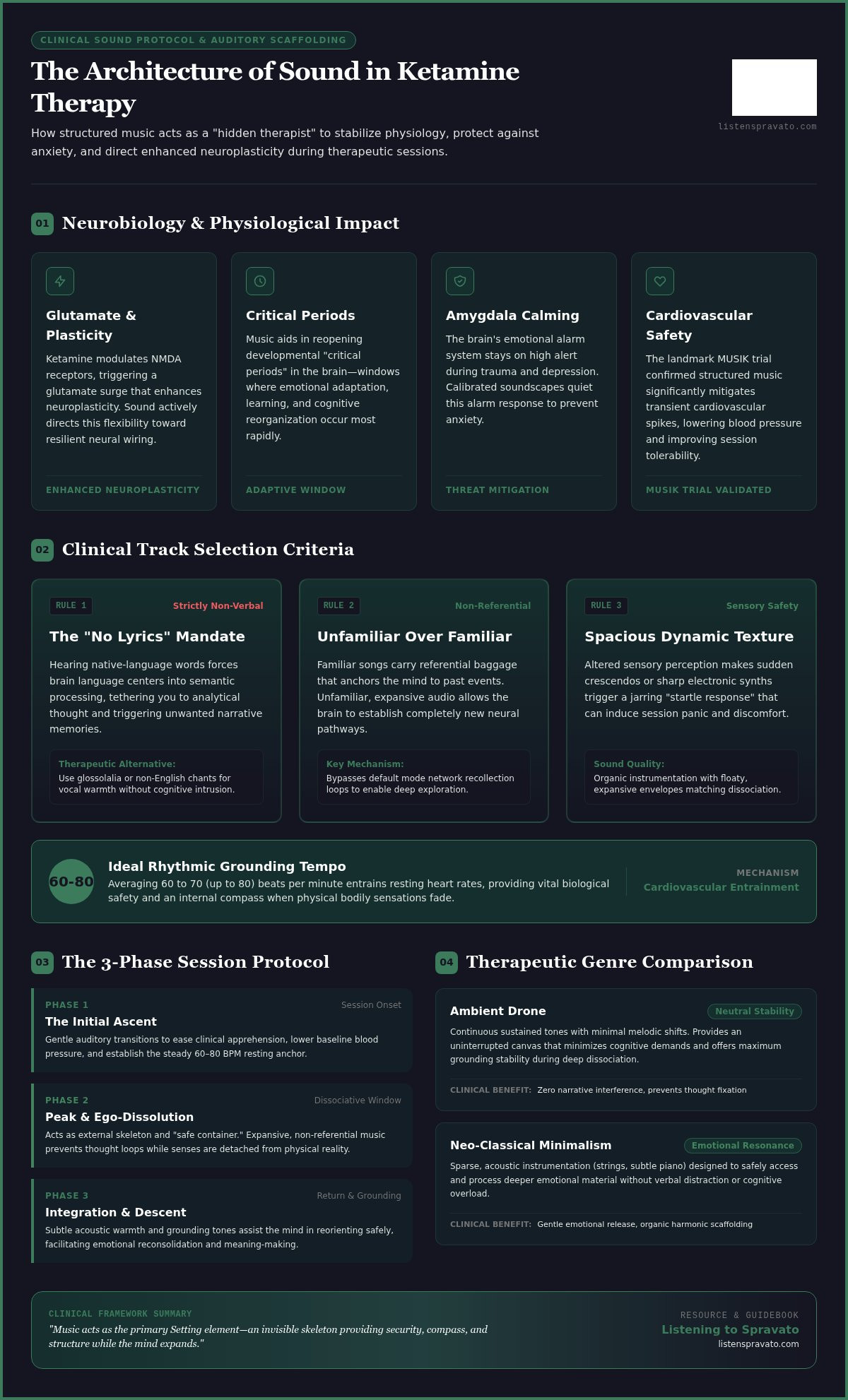
Ketamine therapy isn't merely a chemical event. It's a sensory experience. Within the framework of ketamine-assisted psychotherapy, music serves as "therapeutic scaffolding." This term describes the invisible structure that supports the psyche as the ego begins to dissolve. Without this support, the dissociative state can feel chaotic or unmoored. When we discuss the best music for ketamine infusion, we're talking about providing a reliable path for the mind to follow. Music acts as the primary "Setting" element, shaping the internal landscape even when the external room disappears.
Physiologically, ketamine modulates NMDA receptors, triggering a surge of glutamate that enhances neuroplasticity. During this window, the brain is uniquely sensitive to external stimuli. Music-assisted therapy is a synergistic approach to neuroplasticity that uses sound to direct the brain's newfound flexibility toward healing. By carefully selecting frequencies and tones, we can help the brain rewire itself in a more resilient pattern.
The Neurobiology of Music and Neuroplasticity
Music facilitates the reopening of "critical periods" in the brain. These are windows of time, usually found in childhood, where learning and emotional adaptation happen most rapidly. The amygdala, our brain's emotional smoke detector, often remains on high alert in those with depression or trauma. The right soundscape calms this alarm system. The landmark MUSIK trial confirmed that structured music significantly mitigates the transient cardiovascular spikes often seen during infusions, lowering blood pressure and enhancing overall tolerability. Interestingly, the best music for ketamine infusion is often unfamiliar. Familiar songs carry referential baggage, pulling you into past memories. Unfamiliar, expansive sounds allow the brain to forge entirely new neural pathways without the weight of the past.
Creating a "Safe Container" for Dissociation
Dissociation involves a temporary distance from your physical self and personal narrative. This can be liberating, but it can also lead to thought loops or anxiety. Music acts as an anchor. It provides a steady point of reference when your sense of time or body fades. This "safe container" ensures that even as you drift, you remain held by the music. It's the difference between being lost at sea and navigating with a compass.
- Non-referential soundscapes: These are sounds without lyrics or recognizable melodies that prevent the mind from getting stuck in verbal processing or semantic networks.
- Rhythmic grounding: Effective tracks often average 60 to 70 beats per minute to entrain resting heart rates, offering a sense of biological safety when physical sensations fade.
Selection Criteria: How to Choose the Best Music for Your Session
Selecting the best music for ketamine infusion requires moving beyond personal preference into the realm of clinical utility. While you might enjoy certain high-energy albums in your daily life, the dissociative state demands a specific type of auditory architecture. This selection process mirrors the therapeutic playlist structure developed by researchers at institutions like Johns Hopkins. It's about creating a safe, predictable environment for the mind to expand. The goal is to choose sounds that facilitate exploration rather than those that demand your attention.
The Problem with Lyrics and Language
Language is a grounding force. When you hear words in your native tongue, your brain's language centers immediately engage to decode meaning. This semantic processing tethers you to your verbal, analytical self. In a therapeutic session, we're aiming for a non-verbal, subconscious experience. Lyrics often carry specific narratives or emotional baggage that can trigger unwanted memories, pulling you out of the present moment. If you feel a need for vocal presence, consider tracks featuring glossolalia or non-English chants. These provide the warmth of the human voice without the cognitive intrusion of literal meaning.
Evaluating Texture and Volume
Texture matters as much as melody. During an infusion, your senses are heightened and your perception of sound changes. Sudden dynamic shifts or sharp crescendos can trigger a "startle response," which might induce panic or physical discomfort. The goal is "spaciousness," a mix that feels as floaty and expansive as the medication itself. We recommend organic instrumentation over harsh, jagged electronic synthesis. Warm cellos, soft pianos, and deep ambient drones provide a resonant foundation that feels both safe and dignified.
Rhythm should remain steady and predictable. Aim for a tempo of 60 to 80 beats per minute, which mirrors a resting heart rate and encourages alpha brainwave states. For a deeper look at how to curate these textures, the Listening to Spravato guidebook offers a refined approach to building your personal library. To preserve the sanctity of the "safe container," attend to these technical details before the infusion begins:
- Use high-quality headphones: Over-ear, active noise-canceling models are the clinical standard to block out medical environment sounds.
- Ad-free streaming: Ensure you're using a premium tier to avoid jarring commercial interruptions that can cause panic in a dissociative state.
- Device settings: Switch your device to "Airplane Mode" and "Do Not Disturb" to prevent notifications from breaking your immersion.
- Seamless transitions: Enable a crossfade of 6 to 8 seconds in your settings to prevent silence between tracks.
Top Genres for Ketamine Therapy: A Comparative Guide
Selecting a genre is like choosing the terrain for your internal journey. While technical criteria like BPM and instrumentation remain constant, the emotional "flavor" of the experience shifts depending on the soundscape's texture. The best music for ketamine infusion provides a consistent atmosphere that aligns with your specific therapeutic goals. It's not just about what sounds pleasant; it's about what supports your particular psychological needs in the moment.
Ambient and Drone: The Expansive Soundscape
Ambient and drone music are widely considered the gold standards for therapeutic sessions. These genres are characterized by long-form structures and a focus on timbre rather than traditional melody. Because they lack a clear "hook," they offer a neutral, expansive state that doesn't demand your attention. This is ideal for patients who feel anxious or overwhelmed by complex musical structures. By removing the narrative pressure of a melody, artists like Brian Eno, Stars of the Lid, and Max Richter create a pillowy, secure environment where the mind can drift without being directed. It's a style that prioritizes "being" over "doing."
Neo-Classical: The Emotional Narrative
For those seeking to process grief or explore deep-seated emotional blocks, Neo-Classical music offers a gentle, structured narrative. This genre utilizes piano, cello, and strings, often blending them with subtle electronic layers to create a cinematic feel. It helps facilitate a "hero’s journey" through the subconscious, providing a sense of resolution and grace. You can learn more about how Music for Spravato: Sound as Therapeutic Scaffolding works to guide these delicate emotional releases. The organic nature of these instruments feels deeply human, offering comfort when the dissociative state feels particularly vast or unfamiliar.
World and tribal music introduce a rhythmic grounding that can be incredibly supportive. Instruments like the wooden flute, frame drum, or hang drum connect the patient to an "earthy" experience. This is especially helpful if you tend to feel too detached from your body or if you're working through somatic trauma. The repetitive, hypnotic nature of these rhythms acts as a steady pulse, reminding the subconscious of its connection to the physical world even as the ego softens.
Bio-acoustics and nature sounds bridge the gap between the clinical room and the natural world, fostering a sense of interconnectedness. However, when curating the best music for ketamine infusion, you should exercise caution with water sounds. Clinical practitioners often avoid tracks featuring running or dripping water. Because ketamine increases bladder awareness, these sounds can cause somatic distraction or anxiety about needing to urinate while you're immobilized. Instead, look for sounds like wind, distant birdsong, or the rustle of leaves to provide a natural, open-air feeling without the physical distraction.
The 3-Phase Protocol: Structuring Your Infusion Playlist
A therapeutic session is a dynamic process, not a static state. As the medicine’s plasma concentration rises and falls, your auditory environment must adapt to support these biological shifts. The best music for ketamine infusion follows a structured arc that mirrors the pharmacological journey. This ensures you aren't met with jarring complexity when you need simplicity, or silence when you need a container. While a standard clinical infusion lasts 40 to 60 minutes, your playlist should run at least 75 to 90 minutes. This prevents the anxiety of a sudden stop while you're still in a vulnerable, dissociative state.
Onset: Leaving the Shore
The first twenty minutes are about transition. You're moving from the clinical reality of the room into an internal space. This is often where anticipatory anxiety is highest, and your heart rate may slightly elevate. Music here should be welcoming, gentle, and grounded. Focus on the Spravato Onset Phase: Music for the First 20 Minutes to help lower your guard. Soft piano or light ambient pads work well to anchor your intention without demanding immediate depth. The goal is to signal to your nervous system that it is safe to let go.
The Peak and the Return
Between 20 and 60 minutes, you enter the peak of the experience. This is the window of ego dissolution and deep immersion. The music should become more complex and layered, providing a rich, atmospheric "skeleton" for the mind to lean on. Soundscapes during this phase are often rhythm-less and drone-based. They lack a traditional cadence, which allows for a total sense of expansion. This musical "holding" is vital when your sense of time and physical body begins to fade. It provides the structure necessary to explore the subconscious without feeling lost.
As the medicine begins to clear, the focus shifts to integration. This is the "Return," the gentle descent back to the shore. The music should now signal safety and re-embodiment. By re-introducing familiar, warm instruments like an acoustic guitar or a cello, you provide a bridge back to the physical self. Explore Coming Back: Music for the Spravato Integration Phase to understand how to ground your insights. This final phase isn't just an ending; it's the beginning of the integration process where neuroplasticity is at its highest.
A well-structured playlist ensures you never experience the panic of sudden silence or an abrupt shift in tone. For a complete, professionally curated experience, you can access Curated Spravato Playlists designed specifically for these therapeutic phases.
Maximizing Your Results: Tools for Music-Assisted Healing
Your preparation determines the depth of your experience. While understanding the phases of an infusion is vital, the actual selection of the best music for ketamine infusion requires a more granular, intentional approach. Relying on a random algorithm or a generic streaming playlist can lead to jarring shifts in mood or intensity. These digital tools often lack the meticulous intentionality required for a clinical setting. Instead, we advocate for a curated approach that respects the sensitivity of the neuroplastic window, ensuring that every note serves to either inform or comfort the listener.
The Listening to Spravato Guide
Preparation is the foundation of safety. Justin Page’s work bridges the gap between clinical necessity and artistic expression. As a conservatory-trained musician and a patient himself, he provides a unique perspective that is both technically precise and deeply empathetic. The Spravato Book: Guide for Esketamine Therapy serves as a definitive resource for those looking to master their auditory environment. It includes genre-by-genre guides that help you build a personalized protocol. This level of curation helps both patients and clinicians optimize the experience, moving away from "random" sound and toward a structured, therapeutic soundscape.
Accessing Curated Playlists
Intentionality is the hallmark of a successful session. You can explore Free Spravato Playlists: A Curated Guide to Music-Assisted Healing (2026) to see how these principles are applied in practice. These resources are designed to provide a steady, reliable container for your journey. For those who prefer a more immersive preparation, you can purchase the Listening to Spravato audiobook to hear these principles explained with the warmth and clarity of a guided experience. Hearing the guidance before your session can help settle the nervous system and set a clear intention for the work ahead.
To fully maximize your results, consider the physical environment alongside the auditory one. A contoured blackout eye mask is essential to eliminate visual distractions and deepen the internal focus. Find a comfortable, reclined position that allows your body to relax completely, facilitating a sense of weightlessness. Finally, reserve time immediately after your session for integration journaling. Writing down your insights while the best music for ketamine infusion is still echoing in your mind helps anchor the neuroplastic changes initiated during the treatment. This holistic approach ensures that your journey is not just a temporary shift in perspective, but a lasting foundation for healing.
Orchestrating Your Path to Healing
The journey through ketamine therapy is a profound act of vulnerability and courage. By understanding the three-phase protocol and the technical requirements of therapeutic sound, you transform a clinical appointment into a structured sanctuary for growth. You now have the framework to move beyond random playlists and toward a curated experience that respects your mind's neuroplastic window. Selecting the best music for ketamine infusion is ultimately about providing yourself with the safety and dignity required for deep psychological work.
For those seeking a more comprehensive roadmap, the Listening to Spravato guide offers the definitive expansion of these principles. Authored by a conservatory-trained musician and patient, this resource is recommended by top Spravato clinics for its blend of clinical protocol and musical expertise. It is available in Print, Kindle, and Audiobook formats to support you at every stage of your recovery. Get the "Listening to Spravato" Guide on Amazon today to refine your personal healing protocol. Your path to resonance and clarity is waiting; trust the music to lead the way.
Frequently Asked Questions
Can I listen to my favorite songs during a ketamine infusion?
You should generally avoid listening to your favorite songs during a session. Personal favorites often carry deep emotional anchors or specific memories that can pull you out of the present moment and into a past narrative. The goal is to explore the subconscious without being directed by familiar melodies. Choosing the best music for ketamine infusion ensures that your mind remains free to forge new neural pathways without the weight of nostalgia.
Why is instrumental music preferred over music with lyrics?
Instrumental music is preferred because lyrics engage the brain’s language centers and semantic networks. This verbal processing keeps you tethered to your analytical, everyday self, which can interfere with the non-verbal, dissociative experience. By removing words, you eliminate the risk of specific linguistic triggers. This allows the mind to navigate more abstract, emotional, and symbolic territories. It’s about maintaining the safe container required for your inner journey to unfold naturally.
Should I use noise-canceling headphones for my session?
You should definitely use high-quality, over-ear noise-canceling headphones for your session. Clinics are often filled with distracting medical sounds, such as beeping monitors or staff conversations, which can cause a startle response in a heightened state. Active noise cancellation creates an isolated auditory environment, allowing you to remain fully immersed in your soundscape. This hardware is a critical part of the setting that ensures your session remains undisturbed, focused, and deeply resonant.
What happens if I don’t like the music during my infusion?
If you find the music distressing or unpleasant during an infusion, it can lead to anxiety or a difficult experience. It’s essential to pre-screen your playlist before the session begins to ensure you feel safe with the sounds. However, you shouldn't try to change the music during the peak of dissociation, as fine motor tasks are difficult. If you feel overwhelmed, try to focus on your breath and remember that the music is a steady anchor.
Is there a specific "ketamine frequency" (like 432Hz) that works best?
There isn’t a single magic frequency like 432Hz that has been clinically proven to improve outcomes over others. However, the best music for ketamine infusion often utilizes specific rhythmic entrainment. We recommend music that stays within 60 to 80 beats per minute to match a resting heart rate. While some patients find comfort in solfeggio frequencies or binaural beats, the overall texture and lack of sudden dynamic shifts are more important for maintaining a stable state.
Can I use a Spotify playlist, or should I download the music?
You can use a Spotify playlist, but we strongly recommend downloading the music for offline use. Relying on a live connection can lead to buffering or dropouts, which are jarring during a dissociative state. If you use a streaming service, ensure you have a premium, ad-free subscription. One commercial interruption can trigger a panic response. Always set your device to Do Not Disturb and Airplane Mode to prevent any notifications from breaking your immersion during treatment.
How long should my ketamine therapy playlist be?
Your playlist should be at least 75 to 90 minutes long. Even though a standard IV infusion lasts about 40 to 60 minutes, you need extra time for the onset and the integration phases. Having a longer playlist ensures you don't experience sudden silence while you're still coming out of the dissociative state. This extra padding provides a gentle return to the shore, allowing you to re-orient at your own pace without feeling rushed or startled.
Does the music choice differ between IV ketamine and Spravato nasal spray?
The core principles of non-verbal, spacious sound remain the same for both IV ketamine and Spravato. However, the timing of the onset phase differs. Spravato nasal spray generally has a slower, more gradual ascent compared to the rapid onset of an IV infusion. You might want a longer onset section in your Spravato playlist to account for this slower absorption. Regardless of the method, the goal is always to match the music’s intensity to the medicine’s concentration.


