

What if the mandatory two-hour observation window isn't merely a regulatory hurdle to endure, but the decisive therapeutic terrain of esketamine care? Every provider understands the operational strain of managing acute dissociative episodes in an active practice. When clinical sterility and unexpected ambient noise collide, sensory overload can quickly overwhelm a patient, sparking panic, draining staff resources, and jeopardizing treatment adherence. To protect both patient comfort and clinic workflow, this Spravato guide for clinicians introduces an evidence-informed sensory and acoustic framework tailored directly to the 120-minute arc.
You already know that neuroplasticity requires perceived safety. By introducing structured acoustic scaffolding alongside deliberate environmental controls, you can gently anchor patient perception and ease clinician monitoring duties without disrupting routine practice. Ahead, we outline practical, non-pharmacological strategies to replace unpredictable distress with calm, repeatable protocols that elevate care throughout your REMS suite.
Key Takeaways
- Transform the mandatory 120-minute observation window from a passive regulatory checkpoint into an intentional sensory container that nurtures emotional safety.
- Discover why auditory pathways remain resilient during NMDA receptor antagonism, making this Spravato guide for clinicians essential for grounding disrupted perceptions.
- Learn how intentional acoustic curves and appropriate hardware prevent the abrupt transitions and sensory overload common to standard consumer playlists.
- Establish a repeatable, staff-led protocol that integrates environmental staging seamlessly into routine pre-dose vital checks and monitoring workflows.
- Implement structured operational references to ease staff monitoring burdens, mitigate difficult dissociative episodes, and protect treatment continuity.
Clinical Protocols Beyond REMS: Structuring the 120-Minute Spravato Session
Mandatory REMS compliance ensures foundational physical safety. It requires pre-dose vital signs, post-administration blood pressure checks around minute 40, and mandatory release evaluations at minute 120. Yet checking boxes on a registry sheet leaves the patient's internal state entirely unmanaged. When clinics view this observation window solely as passive transit time, they miss a profound neuroplastic opportunity. A comprehensive Esketamine (Spravato) protocol must look past bare administrative minimums to deliberately scaffold the psychological experience. In doing so, practices decrease reactive staff interventions while establishing an environment where deep therapeutic shifts can securely unfold.
The Three Clinical Phases of Esketamine Observation
The 120-minute journey divides naturally into three distinct neurological and sensory movements:
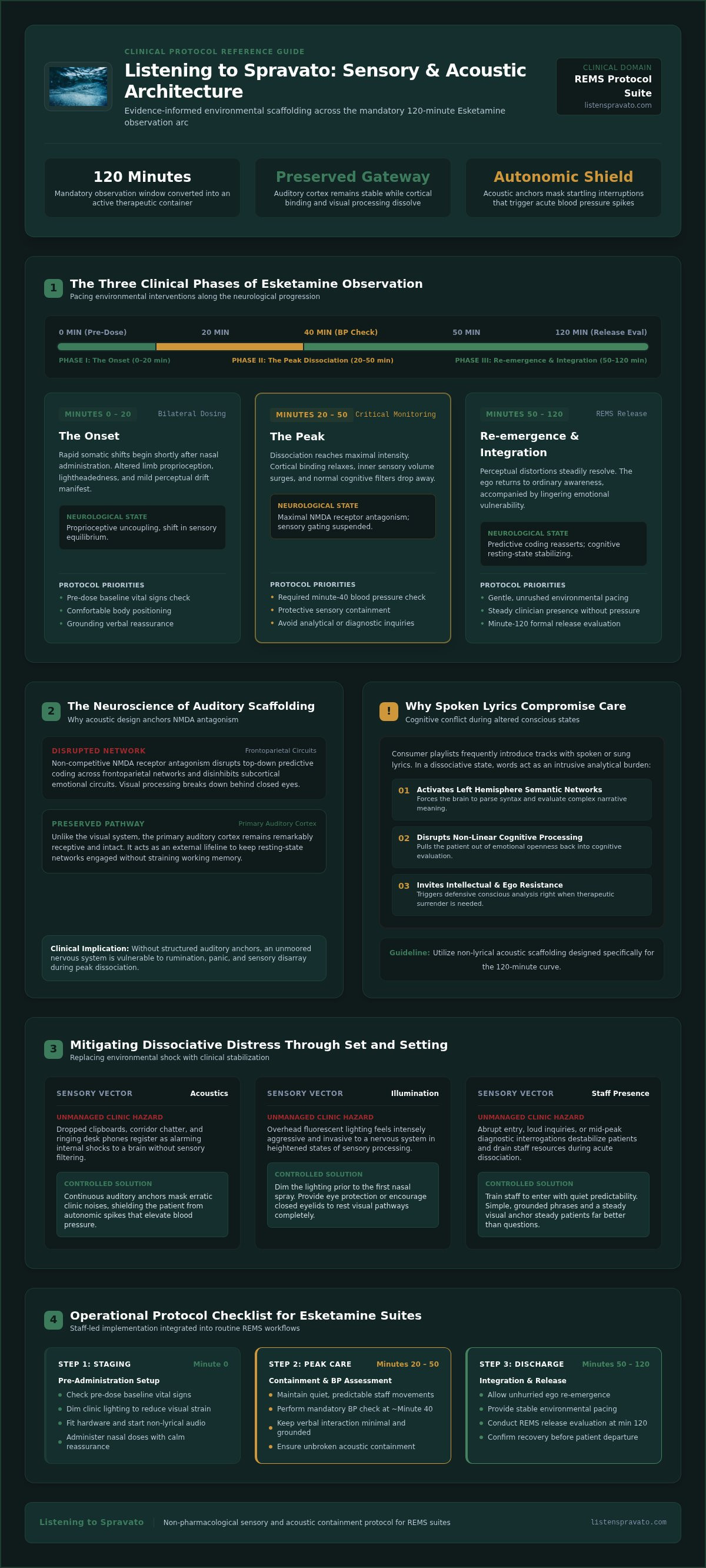
- The Onset (Minutes 0 to 20): Somatic sensations shift rapidly. Bilateral nasal administration gives way to lightheadedness, altered limb proprioception, and mild perceptual drift. Grounding verbal reassurance and comfortable body positioning help prevent early apprehension.
- The Peak (Minutes 20 to 50): Dissociation reaches maximal intensity. Cortical binding relaxes, inner sensory volume surges, and normal cognitive filters drop away. This acute window demands protective sensory containment to prevent disorienting panic.
- The Re-emergence and Integration (Minutes 50 to 120): Perceptual distortions steadily resolve. The ego returns to ordinary awareness alongside lingering emotional vulnerability. Re-entry requires stable, gentle environmental pacing rather than abrupt clinical questions.
Mitigating Dissociative Distress Through Set and Setting
Under non-competitive NMDA receptor antagonism, the brain loses its ability to filter incoming sensory stimuli. Overhead fluorescent lighting feels aggressive and invasive to a nervous system in heightened states of sensory processing. Unexpected ambient interruptions, such as dropped clipboards, ringing desk phones, or corridor chatter, register as alarming internal shocks. These acoustic intrusions trigger sudden autonomic spikes, raising blood pressure right when clinicians need it stable.
An actionable spravato guide for clinicians prioritizes the clinical container just as rigorously as dosage titration. Dim the lighting before the first spray is administered. Introduce continuous auditory anchors to mask erratic clinic noises, and train staff to enter rooms with deliberate, quiet predictability. Clinician presence should project calm, non-intrusive reassurance. A simple, grounded phrase or a steadying visual presence anchors an unmoored patient far more effectively than mid-peak diagnostic inquiries. By mastering the physical environment, your team protects both clinical outcomes and staff capacity.
The Neuroscience of Auditory Scaffolding in NMDA Receptor Antagonism
Esketamine functions as a non-competitive NMDA receptor antagonist, interrupting top-down predictive coding across frontoparietal networks while disinhibiting subcortical emotional circuits. As visual processing dissolves behind closed eyelids, the primary auditory cortex stays remarkably receptive and intact. This preserved sensory gateway functions as a stabilizing lifeline. Real-world insights from major programs, including VA esketamine treatments, highlight how deeply sensory input shapes the acute psychiatric response during observation. Without intentional auditory anchors, an unmoored nervous system easily falls into rumination or panic. Deliberate acoustic design gently engages resting-state networks without overwhelming fragile working memory. For deeper neurological insights, explore the science of music for spravato treatment and how precise auditory stimuli sustain clinical composure.
Why Spoken Lyrics Compromise Clinical Containment
Spoken or sung words activate complex semantic networks in the left hemisphere. When language enters the dissociative state, it forces the brain to analyze meaning, parse syntax, and evaluate narrative content. This analytical burden disrupts non-linear cognitive processing and invites intellectual resistance. Lyrical tracks also introduce unpredictable autobiographical memory associations, which can suddenly evoke personal trauma or acute grief. Unstructured acoustic choices compromise patient safety. Lyric-free soundscapes bypass linguistic parsing entirely, offering neutral space for autonomous emotional unfolding.
Acoustic Architecture: Timbre, Harmonic Pacing, and Dynamics
Sound in an esketamine suite must obey specific psychoacoustic rules:
- Dynamic Stability: Sudden volume spikes or sharp transients ignite startle reflexes, driving sympathetic arousal and unwanted blood pressure spikes.
- Organic Timbre: Warm, rounded analog frequencies and continuous low-frequency drones soothe vestibular disorientation, countering treatment-induced nausea.
- Modal Pacing: Non-resolving modal progressions create a feeling of gentle suspension. They hold emotional space without forcing premature psychological resolution.
Equipping your clinic with an intentional spravato guide for clinicians ensures staff aren't relying on guesswork when supporting altered states. Incorporating evidence-informed tools from Listening to Spravato provides practical acoustic scaffolding that protects patient dignity and relieves clinical monitoring burdens.
Evaluating Clinical Music Delivery: Headphone Selection and Playlist Design
Delivering acoustic scaffolding requires deliberate physical tools. Too often, clinics hand patients ill-fitting consumer earbuds or let them stream unvetted public playlists. Consumer streaming algorithms are inherently volatile. Jarring tempo shifts, abrupt volume spikes, or jarring ads instantly shatter therapeutic immersion. Standardizing audio delivery transforms variable patient responses into predictable clinical courses, giving staff a reliable framework for every session.
Hardware Comparison: Clinic-Grade Audio Tools
Physical comfort directly governs psychological ease during altered perception. Tight headbands induce tension headaches, while loose earbuds invite compulsive fidgeting. Selecting the right hardware requires balancing acoustic isolation with clinic hygiene:
- Over-Ear Active Noise-Cancelling Headphones: These offer superior containment. High-grade active noise cancellation seals out sudden clinic sounds, allowing deep immersion. Units must feature non-porous, wipeable ear cushions that endure hospital-grade disinfectants between sessions without degrading.
- Bone-Conduction Headsets: By bypassing the eardrum and leaving the ear canal open, these devices allow patients to hear background audio while clinicians perform blood pressure checks or offer verbal grounding without removing equipment.
Architecting Playlists to Match Esketamine Pharmacokinetics
Sound cannot remain static across the mandatory observation period. Playlists must synchronize directly with the pharmacokinetic curve of esketamine, moving in tandem with plasma concentration shifts. Early compositions should feature gentle, spacious drones that mirror a resting heart rate and soothe pre-dose apprehension. As plasma concentration peaks, rich harmonic layers provide a supportive emotional safety net that holds space through deep perceptual drift.
During the final hour, the acoustic profile should evolve. Gentle melodic phrasing and warm acoustic instruments guide the patient back toward waking reality, promoting clear emotional reflection rather than disorientation. For an inside look at how patients experience these auditory transitions, consult our detailed spravato patient guide. Integrating these precise acoustic considerations into your spravato guide for clinicians ensures your team delivers a seamless, dignified therapeutic container every single visit.
Step-by-Step Implementation Guide for Esketamine Suites
Operational success hinges on repeatability. When non-physician staff manage sensory staging with the same discipline applied to blood pressure checks, acute patient distress plummets. Establishing a turnkey checklist transforms the treatment bay into a predictable refuge, significantly reducing anxiety-related calls to attending medical directors. This practical spravato guide for clinicians outlines how to weave environmental preparation directly into routine intake workflows.
Pre-Session Preparation: Setting the Clinical Room Container
Staff should ready the room environment ten minutes before rooming the patient:
- Lighting and Acoustics: Dim ambient fixtures to lower retinal excitation. Turn off buzzing fluorescent fixtures, and verify sound-dampening door sweeps are intact.
- Ergonomics: Calibrate zero-gravity recliners to support the cervical spine and lumbar region, accommodating sudden vestibular relaxation and motor heaviness.
- Acoustic Readiness: Confirm headphones are sanitized, paired, and set to offline playback to prevent abrupt streaming buffering or unwanted notification pings.
Patient Briefing: Priming the Internal Mindset
Clear pre-dose expectations dismantle fear. During baseline vital checks, explain that the audio acts as a stabilizing ground wire throughout the session. Encourage patients to keep their contoured eye shades in place, which prevents external visual distortion from overwhelming fragile sensory filters. Establish a simple non-verbal communication system, such as a raised hand or basic finger signals. Knowing they can communicate urgent physical needs without forcing slurred speech provides immense psychological relief during the drug peak.
Post-Peak Grounding and Discharge Protocols
As the acute peak wanes between minutes 60 and 90, the acoustic environment should gently transition from abstract ambient soundscapes to grounding organic instrumentation. This musical evolution mirrors natural neurochemical stabilization. Provide twenty minutes of undisturbed room rest before re-introducing normal ambient light and initiating conversational check-ins. Rushing into diagnostic questionnaires can disrupt emotional integration. Conclude with required discharge evaluations at minute 120 once orientation is fully established. To standardize this framework across your treatment rooms, order the Listening to Spravato staff reference manual and curated audio protocols for your clinical team.
Equipping Your Practice: The Listening to Spravato Clinical Resource
Administering esketamine without an experiential framework leaves valuable therapeutic potential on the table. Bridging neurochemical intervention with structured acoustic scaffolding elevates standard care, transforming passive observation into an aligned clinical ritual. Authored by Justin Page, a conservatory-trained musician and experienced patient, Listening to Spravato translates psychoacoustic principles into an operational desk reference for outpatient psychiatric settings. Clinic staff can consult phase-specific sound recommendations, detailed genre analyses, and pharmacokinetic mappings right at the point of care. For an in-depth clinical overview of this foundational literature, review our guide to the listening to spravato book.
Standardizing Practice Protocols Across Your Treatment Team
Rotating clinic schedules and varied staffing models often lead to inconsistent patient experiences. Integrating a clear spravato guide for clinicians provides nurses and medical assistants with shared boundaries for supportive, non-intrusive interaction. When staff understand how to hold space without over-monitoring or interrupting the arc, patients navigating treatment-resistant depression feel secure enough to soften their internal resistance. Consistent clinical protocols protect staff capacity across rotating shifts, creating dependable containment throughout the entire 120-minute monitoring window.
Accessing Print, Digital, and Audiobook Clinical References
Different clinical workflows call for adaptable formats to support providers and patients alike:
- Listening to Spravato® (Print Edition): Place this reference directly in observation suites, giving monitoring staff an immediate physical manual for pharmacokinetic intervals and non-pharmacological grounding cues.
- Listening to Spravato® (Digital/Kindle Edition): Deploy digital copies across clinical tablets for rapid staff onboarding and seamless cross-site training across multiple treatment rooms.
- Listening to Spravato® (Audiobook): Offer this format to help prospective patients understand sensory changes ahead of time, easing anticipatory anxiety prior to their first administration.
- Curated Spravato® Playlists: Pair these reference materials with intentional, commercial-free auditory sequences mapped directly to the pharmacokinetic session curve.
Transforming Esketamine Observation into Therapeutic Scaffolding
The mandatory two-hour window doesn't have to remain an operational bottleneck or an unpredictable sensory hurdle. By shifting from passive physical surveillance to proactive sensory containment, your practice protects patient dignity while substantially easing staff workload. Grounding the dissociative curve with intentional acoustic pacing turns a vulnerable interval into a reassuring, repeatable container.
Authored by a conservatory-trained musician and experienced Spravato patient, this evidence-informed spravato guide for clinicians bridges neurobiology with practical room staging. Featuring phase-mapped protocols built specifically for the 120-minute esketamine arc, these methods are already adopted by innovative interventional psychiatry suites nationwide to foster serene patient sessions. Equip your clinic with the Listening to Spravato guide today to bring steady confidence and therapeutic elegance to every treatment.
Frequently Asked Questions
Why is music selection considered clinically significant during Spravato treatment?
Sound acts as a direct perceptual scaffold when esketamine disrupts habitual neural filtering. Carefully chosen compositions bypass analytical resistance, anchoring awareness while preventing sensory disorientation. In an evidence-based spravato guide for clinicians, music is treated not as passive entertainment, but as an intentional non-pharmacological stabilizer that maintains emotional safety, supports vegetative stability, and reduces acute treatment-related distress across the two-hour observation period.
How does acoustic scaffolding reduce patient anxiety during NMDA receptor peak activity?
During peak NMDA receptor antagonism between minutes 20 and 50, ego dissolution and altered proprioception can trigger acute fear. Predictable acoustic scaffolding provides continuous sensory grounding that prevents the nervous system from interpreting strange somatic feedback as physical danger. Steady, non-resolving auditory textures anchor subcortical emotional centers, keeping autonomic arousal low and stabilizing vital signs without requiring intrusive verbal interventions from clinic staff.
Can patients select their personal playlists during clinical Spravato observation?
While patient autonomy matters, uncurated personal playlists carry real clinical risks. Familiar songs frequently contain sudden tempo shifts, aggressive percussive hits, or lyrical themes tied to past autobiographical trauma. Under dissociative states, these unexpected musical triggers can spark sudden panic or ruminative looping. Clinicians should guide patients toward pre-screened, phase-aligned acoustic sequences designed specifically for the neurochemical arc while respecting personal aesthetic comfort.
What physical hardware provides the most effective sound delivery in clinic suites?
Over-ear active noise-cancelling headphones equipped with medical-grade, wipeable synthetic leather ear cushions offer the best containment. They block out door clicks, phone rings, and hallway steps while resting comfortably on the skull. For patients who feel claustrophobic or require continuous verbal contact with staff, open-ear bone-conduction headsets provide a practical alternative, allowing clear ambient communication alongside steady auditory grounding.
How does acoustic staging support clinics during mandatory REMS compliance observation?
REMS mandates a strict two-hour monitoring period, but physical vital checks don't address psychological distress. Acoustic staging establishes an orderly, soothing environment that reduces distress calls and minimizes acute mid-session escalations. By implementing a standardized spravato guide for clinicians, nursing staff spend less time managing unpredictable behavioral emergence and more time maintaining smooth operational workflow across multi-chair treatment suites.
What specific music characteristics should clinicians avoid in treatment rooms?
Avoid tracks with spoken or sung lyrics, which trigger linguistic processing and analytical tension. Clinicians should also exclude sudden dynamic shifts, sharp polyrhythms, dissonant brass crescendos, and commercial streaming apps that insert unvetted advertisements. Compositions with rapid chord changes or overly sentimental melodic lines can also induce emotional exhaustion, distracting the patient from organic, autonomous therapeutic processing.
How can clinical teams introduce sound-based protocols to skeptical psychiatric patients?
Frame the acoustic protocol as a clinical seatbelt rather than an aesthetic preference. Explain during intake that esketamine temporarily alters sensory perception, making random clinic noises feel startling. Presenting the music as an intentional tool mapped to the drug's timeline helps patients feel protected and prepared. Clarify that structured sound keeps them grounded throughout the experience, fostering trust before the first spray is administered.


