

Auditory architecture is not ambient background noise; it is clinical scaffolding that directly stabilizes esketamine pharmacodynamics. When integrating music into Spravato clinic sessions, providers transform a fragile sensory setting into a grounded, reproducible anchor. You already know the daily friction of leaving sound to chance. Without structure, peak dissociation can quickly trigger intense anxiety and sensory overwhelm, while clinical staff spend valuable administrative time managing patient phones, volume spikes, and unvetted streaming playlists.
Sound shouldn't complicate your treatment rooms; it must work in service of patient safety and clinical calm. In this clinician guide, you will learn how to build, standardize, and implement an evidence-based acoustic framework tailored specifically to your psychiatric practice. We will explore how to map dynamic acoustic phases directly to the standard 120-minute REMS observation window, mitigate emergence distress, and establish clear operational protocols for audio hardware, sanitization, and lyric restrictions.
Key Takeaways
- Understand how esketamine alters thalamic sensory gating, making intentional sound architecture essential for preventing sensory overload during altered neurochemical states.
- Discover the practical advantages of integrating music into Spravato clinic workflows by aligning three distinct auditory stages with the mandatory 120-minute REMS observation window.
- Identify clinic-grade operational standards for closed-back over-ear headphones, dedicated playback devices, and infection-control sanitization between patient visits.
- Learn why eliminating lyrical content and familiar autobiographical music prevents cognitive exhaustion, emotional triggers, and mid-session emergence distress.
- Streamline nursing responsibilities and eliminate pre-session preparation bottlenecks by adopting validated, turnkey patient audio frameworks.
The Clinical Rationale: Why Auditory Scaffolding Protects the Esketamine Experience
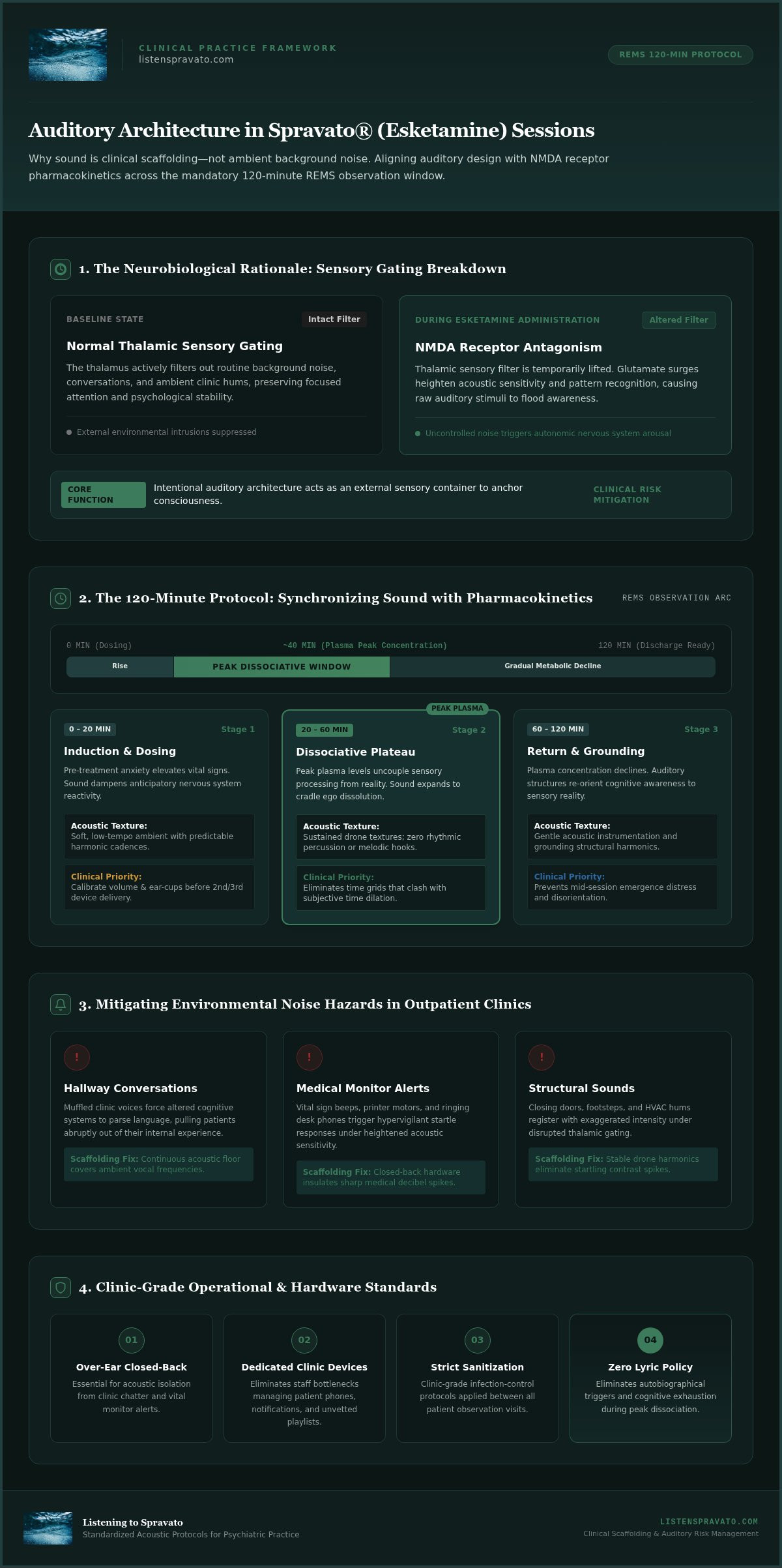
Auditory scaffolding is the intentional design of an acoustic environment to hold and stabilize altered sensory perception. When patients receive esketamine, the brain undergoes a profound neurochemical shift. Sensory boundaries dissolve. Without a stable acoustic container, ambient clinical sounds quickly morph into sources of distress. Integrating music into Spravato clinic protocols isn't about spa-like luxury; it's a critical safety measure that provides steady grounding while customary perceptual filters fall away.
Neurobiology of Sensory Gating During NMDA Receptor Antagonism
Esketamine, the S-enantiomer of Ketamine, binds to N-methyl-D-aspartate (NMDA) receptors across the central nervous system. This action alters thalamic sensory gating. Usually, the thalamus suppresses background noise to keep attention focused. NMDA antagonism temporarily lifts this filter, allowing raw acoustic stimuli to flood conscious awareness. Downstream glutamate surges heighten both acoustic sensitivity and pattern recognition, meaning an irregular, chaotic sound environment can rapidly induce autonomic nervous system arousal. A continuous, intentional acoustic framework acts as an external anchor, dampening fight-or-flight reactivity and sustaining psychological safety throughout the treatment arc.
Mitigating Environmental Noise Pollution in Outpatient Clinics
Modern outpatient practices are noisy environments. Routine clinic activity easily punctures an esketamine session when sound isn't actively controlled:
- Hallway conversations: Muffled voices force altered cognitive systems to parse language, pulling patients abruptly out of their internal experience.
- Medical equipment alerts: Vital sign monitor beeps, printer motors, and ringing desk phones trigger hypervigilant startle responses.
- Structural sounds: Closing doors, heavy footsteps, and HVAC hums register with exaggerated intensity under altered thalamic gating.
These intrusions disrupt default mode network down-regulation, which is central to the therapeutic window. When noise interrupts this balance, patients often grapple with sudden disorientation or distress. Successfully integrating music into Spravato clinic settings neutralizes these erratic spikes, treating noise mitigation as an indispensable risk-management protocol rather than an optional comfort measure.
Mapping the 120-Minute Protocol: Synchronizing Music with Esketamine Pharmacokinetics
Administering intranasal esketamine initiates a defined physiological timeline. Plasma concentrations rise swiftly, peaking around forty minutes post-dose before gradually declining over the remainder of the session. Successful auditory scaffolding mirrors this pharmacokinetic curve directly. By aligning sound textures with the patient's shifting neurochemistry, clinicians can prevent emergence distress and anchor the dissociative experience. Integrating music into Spravato clinic operations works best when divided into three clear operational stages across the observation window.
Phase One: Induction, Settling, and Dosing (0–20 Minutes)
Pre-treatment anxiety often spikes baseline vital signs. During the first twenty minutes, sound should quiet the nervous system rather than challenge it. Soft, low-tempo ambient pieces with predictable harmonic cadences help ease anticipatory tension while staff supervise nasal device administration. Clinical teams should calibrate headphone volume and ear-cup placement before the second or third device is delivered; once dissociation takes hold, fine motor coordination declines rapidly, making self-adjustment frustrating for the patient.
Phase Two: Peak Dissociative Plateau (20–60 Minutes)
Plasma levels peak during this middle window, uncoupling sensory processing from everyday reality. Sound must expand to match this internal opening:
- Omit rhythmic percussion: Strong beats impose a rigid temporal grid that clashes with subjective time dilation.
- Select sustained drone textures: Broad, continuous tones create a supportive floor that cradles ego dissolution without demanding attention.
- Eliminate melodic hooks: Catchy leads force analytical evaluation, pulling the mind back into active processing when it should rest.
For practices refining their procedural flow, reviewing practical strategies for optimizing the 120-minute Spravato window clarifies how continuous sound fits between routine monitoring checks.
Phase Three: Cognitive Re-emergence and Integration (60–120 Minutes)
As drug plasma levels diminish, patients begin reorienting to bodily sensations and the physical room. Acoustic structures should gently lead this return. Reintroducing delicate acoustic instrumentation, such as warm piano chords, bowed strings, and soft organic field recordings, gives the emerging consciousness a tactile reference point. These welcoming arrangements support emotional integration while nursing staff complete final blood pressure verifications and discharge documentation. Clinics looking to simplify this dynamic pacing often consult listenspravato.com for structured listening frameworks built specifically around clinical observation timeframes.
Clinic Hardware, Sanitization, and Operational Setup
A thoughtfully composed soundscape falls flat if the delivery hardware fails. Poor physical fit, dying batteries, or abrupt notification chimes instantly fracture therapeutic immersion. Successfully integrating music into Spravato clinic routines demands durable, medical-grade audio equipment paired with foolproof operating procedures.
Selecting Clinical Audio Hardware: Over-Ear vs. In-Ear Solutions
Closed-back, over-ear headphones are the gold standard for outpatient treatment bays. Earbuds often cause canal tenderness during two-hour recumbent sessions, and they easily slip out when patients shift in the treatment chair. In contrast, over-ear models provide reliable passive acoustic isolation, blocking clinic chatter while reproducing the full acoustic spectrum of grounding bass drones. Choose headphones with replaceable, non-porous synthetic leather pads rather than velour fabric. Pairing these with contoured eye masks eliminates room glare and visual distortion, cocooning the patient in a dedicated sensory space.
Sanitization and Device Management Workflow
Maintaining strict infection control protects your patients and extends hardware life:
- Use quaternary ammonium wipes: Disinfect headsets between sessions using alcohol-free, hospital-grade wipes. High-concentration alcohol degrades synthetic ear cushions, causing micro-tears that harbor pathogens.
- Stock disposable covers: Keep sheer, medical-grade ear-cup covers available for immunocompromised patients or those with sensory sensitivities around shared surfaces.
- Standardize a charging protocol: Return devices to designated multi-port charging stations immediately following post-session wipe-downs. A dead battery midway through peak dissociation induces sudden disorientation.
Configuring Playback Systems for Uninterrupted Delivery
Relying on patient smartphones introduces severe clinical vulnerabilities. An incoming text alert, phone call, or sudden low-battery ping pulls the patient violently from their internal processing. Provide dedicated, clinic-owned tablets or media players instead. Switch these devices into permanent Airplane Mode with Wi-Fi disabled, running locally downloaded tracks to eliminate buffering stutters during high clinic internet usage. Finally, lock the hardware volume limiter in the system settings. This prevents patients from inadvertently blasting their eardrums during periods of motor incoordination, ensuring safe, continuous auditory stabilization.
Addressing Clinical Challenges: Lyrics, Patient Resistance, and Overstimulation
Even carefully calibrated audio setups encounter human variables. Patients arrive with personal listening habits, pre-existing musical associations, and differing thresholds for sensory input. When integrating music into Spravato clinic routines, providers frequently navigate patient requests for familiar pop songs, podcasts, or guided tracks. Protecting the therapeutic window requires understanding the neurological friction these choices create and having standardized scripts to address them gracefully.
The Clinical Case Against Lyrical Music and Guided Meditation
Lyrical music activates Broca's and Wernicke's areas. When human speech or singing enters the auditory cortex, the brain instinctively works to decode semantics, syntax, and narrative meaning. Esketamine temporarily down-regulates higher-order cognitive processing to facilitate deep, unconstrained emotional shifts. Lyrics disrupt this biological reset by demanding analytical attention. Similarly, familiar songs carry autobiographical associations, risking acute emotional distress or uncontrolled rumination. Even spoken meditations often feel intrusive or coercive during altered states, forcing an artificial direction onto an emerging journey. For a deeper neuroacoustic breakdown, explore our detailed analysis of sound as therapeutic scaffolding.
Managing Patient Preferences: Clinician Scripting and Psychoeducation
Patients often request their favorite tracks or true-crime podcasts out of an understandable desire for control. Frame acoustic boundaries as medical recommendations rather than clinic prohibitions:
- The cognitive rest script: "During treatment, your brain's language processing centers need a complete break. Spoken words or singing force your mind to analyze lyrics, which works directly against the deep physical relaxation we're aiming for today."
- The blank canvas script: "Familiar songs carry memories from your past. We use carefully arranged, wordless soundscapes so your mind has a clean, quiet space to process without old associations pulling your attention backward."
Troubleshooting Acute Sensory Overload and Distress
Sensory overstimulation requires prompt, gentle intervention. Watch for physical signs of emergence distress: clenched jaws, restless hands pulling at blankets, furrowed brows, or rapid breathing. When these appear, do not abruptly pull off the patient's headphones, as the sudden rush of raw clinic sounds can intensify disorientation. Instead, step to the side of the recliner, speak in a low tone to announce your presence, and gently decrease the device volume by twenty percent. If distress persists, switch to simple, grounding low frequencies or soft ambient room tone before removing the headset entirely. To give your practice proven acoustic resources that eliminate these trial-and-error pitfalls, access vetted clinician tools at listenspravato.com.
Standardizing Practice: Turnkey Protocols with Listening to Spravato
Ad hoc music management burdens clinical staff. When busy nurses must act as impromptu disc jockeys, troubleshooting personal Bluetooth pairings and vetting streaming queues, direct patient care suffers. Integrating music into Spravato clinic workflows requires a structured, turnkey system that removes guesswork from the treatment floor. By standardizing acoustic protocols across your practice, you protect clinical bandwidth, ensure uniform care across multiple treatment bays, and give patients the sensory predictability they need.
Implementing Pre-Curated Phase Playlists in Clinic Workflows
Relying on staff discretion invites friction. One clinician might favor quiet classical recordings while another defaults to modern electronic ambient. This inconsistency creates unpredictable subjective experiences for patients across different induction appointments. Adopting pre-curated Spravato playlists, developed by conservatory-trained musician and experienced patient Justin Page, eliminates these administrative debates. These pathways map directly to the 120-minute REMS observation arc, moving seamlessly through onset, peak, and cognitive return. Clinics can load these validated playlists across dedicated playback devices, allowing nursing teams to initiate the correct sensory trajectory with a single tap.
This operational consistency creates substantial administrative advantages:
- Streamlined intake: Staff assign pre-loaded tracks during the baseline vital check, bypassing device pairing delays.
- Acoustic versatility: Pre-built options across minimalist ambient, neoclassical, and organic instrumentation honor patient temperaments without compromising clinical safety standards.
- Reproducible outcomes: Each session maintains identical phase transitions, helping providers benchmark progress over multi-week induction schedules.
Providing Patient Literature as Treatment Room Scaffolding
Sensory preparation should begin before the patient enters the recliner. Clinical anxiety drops significantly when patients understand what will happen to their perceptual boundaries and why specific soundscapes are used. Keeping the Listening to Spravato clinical guide book in waiting areas and consultation rooms bridges this psychoeducational gap. The text demystifies the connection between NMDA receptor modulation, altered sensory gating, and intentional listening, turning passive recipients into active participants in their healing.
Practices can encourage patients to explore digital or audiobook editions prior to their first visit. When patients arrive already familiar with the three acoustic phases, compliance with lyric-free listening protocols increases dramatically. Standardizing both your physical literature and your auditory architecture transforms the treatment room into a calm, reliable, and deeply supportive clinical environment.
Transforming Outpatient Care Through Standardized Auditory Design
Auditory scaffolding is fundamentally about patient safety, emotional grounding, and operational ease. As you refine your practice, integrating music into Spravato clinic workflows provides the stability patients need when sensory gating dissolves. Moving from haphazard personal playlists to an intentional, three-stage acoustic structure protects vulnerable minds, prevents emergence distress, and restores valuable clinical bandwidth to your nursing staff.
You don't have to build these systems from scratch. Authored by Justin Page, a conservatory-trained musician and experienced Spravato patient, the Listening to Spravato methodology offers a trusted framework deployed across outpatient clinics nationwide. With standardized phase-specific playlists designed precisely for the 120-minute observation window and patient-facing literature for your treatment rooms, you can provide predictable, dignified sensory containers from the very first dose. Explore the Listening to Spravato book and clinical protocols to bring quiet confidence and structured acoustic support to your practice today.
Frequently Asked Questions
Why is structured music necessary during Spravato treatment rather than patient-chosen playlists?
Unvetted personal playlists introduce sudden volume spikes, aggressive percussion, and lyrics that force cognitive processing. During altered states, familiar songs can also trigger unexpected emotional distress or rumination. Integrating music into Spravato clinic protocols ensures every track offers intentional acoustic scaffolding. Standardized soundscapes eliminate jarring surprises, reduce autonomic arousal, and free nursing staff from managing unpredictable streaming queues during critical observation windows.
Can Spravato patients listen to guided meditations or podcasts during their session?
Spoken-word content isn't recommended during esketamine sessions. Spoken language activates Broca's and Wernicke's areas, forcing the auditory cortex to parse narrative logic when the mind needs cognitive release. Guided meditations can feel demanding or coercive as perceptual boundaries dissolve. Wordless, texture-rich ambient music provides non-intrusive emotional support without directing thought patterns or overstimulating fragile sensory networks during peak drug uptake.
What should clinical staff do if a patient experiences auditory overload or panic?
Never yank headphones off abruptly, as raw ambient noise can worsen disorientation. Instead, stand where the patient can see your outline, announce yourself with a low, calm voice, and lower the device volume by twenty percent. If agitation continues, transition the audio to simple, grounding bass frequencies or quiet room ambience. Reassure the patient of their physical safety before gently removing the headset to complete vital sign assessments.
Which headphone style is recommended for clinical Spravato treatment rooms?
Closed-back, over-ear headphones are the ideal standard for outpatient treatment bays. Unlike in-ear buds, which cause canal fatigue and easily fall out during reclined sessions, over-ear cups provide continuous passive noise cancellation against hallway distractions. Choose durable models equipped with non-porous synthetic leather cushions. These materials withstand repeated wipe-downs with hospital disinfectants and maintain an acoustic seal without trapping uncomfortable moisture over two hours.
How do clinic-provided playlists handle the standard 120-minute REMS observation timeline?
Clinic-aligned playlists mirror esketamine's pharmacokinetics across three distinct stages within the 120-minute REMS window. The first twenty minutes feature grounding textures to calm anticipatory blood pressure spikes during self-administration. The peak window, from twenty to sixty minutes, uses expansive, beat-free ambient drones to cradle deep dissociation. The final hour introduces gentle melodic instruments, naturally supporting cognitive re-emergence before discharge. Successfully integrating music into Spravato clinic schedules guarantees consistent session pacing.
How should clinics clean and sanitize audio equipment between patient visits?
Sanitize all hardware using alcohol-free, hospital-grade quaternary ammonium disinfectant wipes immediately following each appointment. High-concentration isopropyl alcohol dries out synthetic leather ear pads, creating micro-fissures that collect debris and bacteria. Wipe headbands, ear cushions, and tablet surfaces thoroughly, allowing the solution to air-dry according to label contact times. Keep single-use, medical-grade fabric covers on hand for immunocompromised patients or those with sensory concerns about shared gear.


